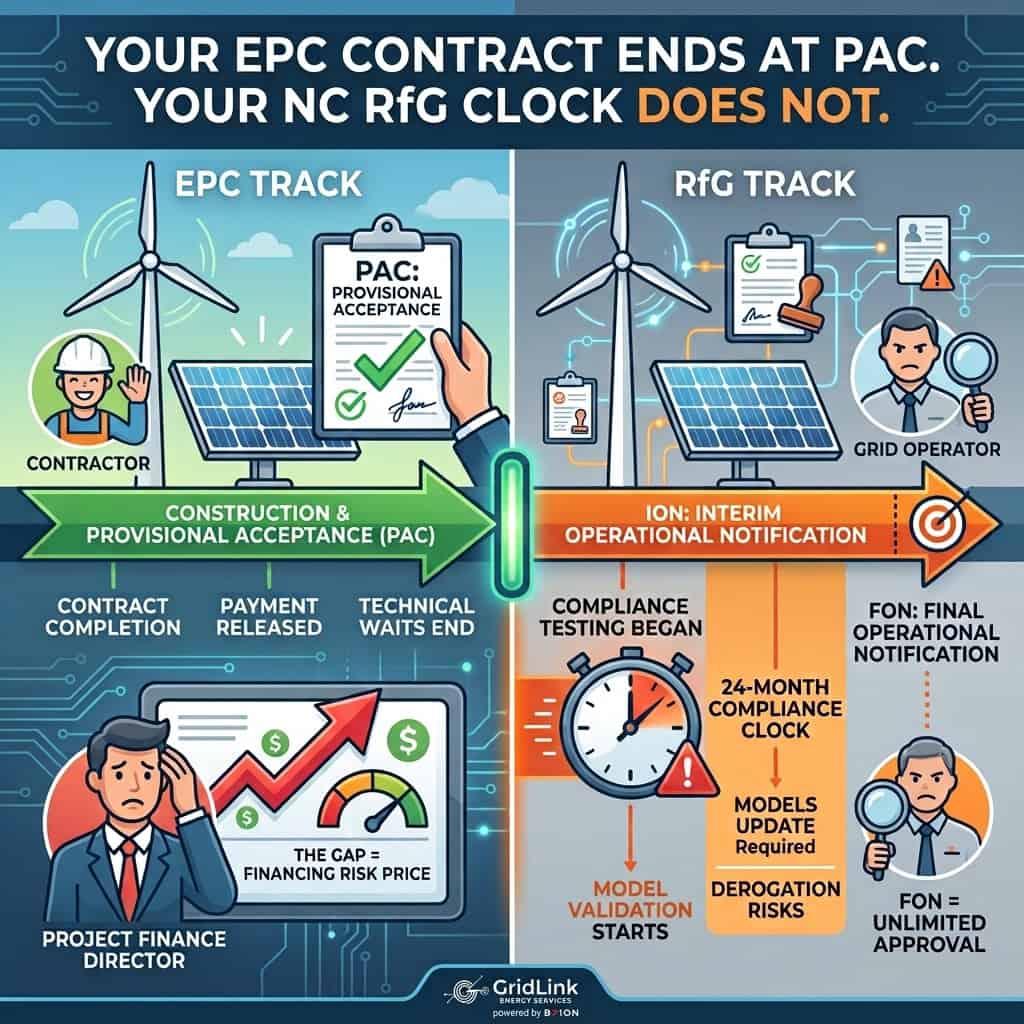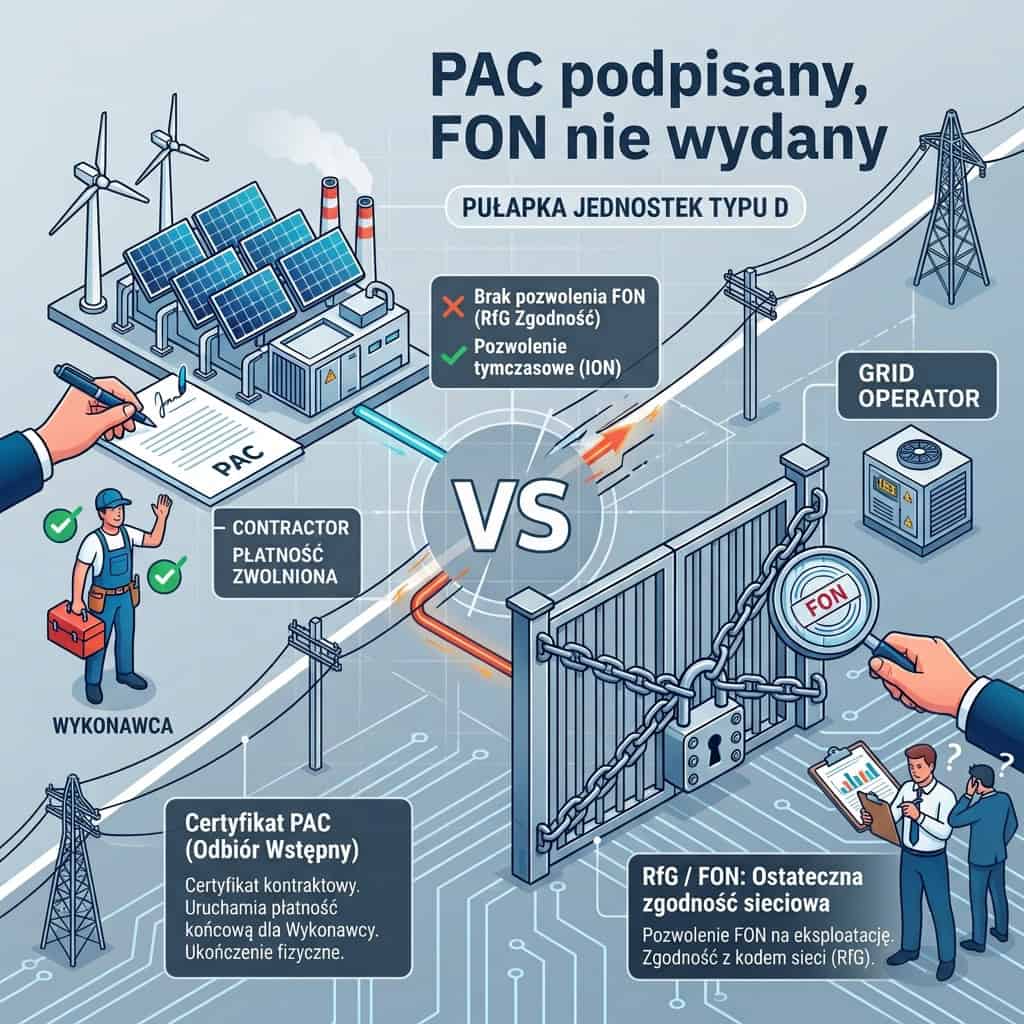
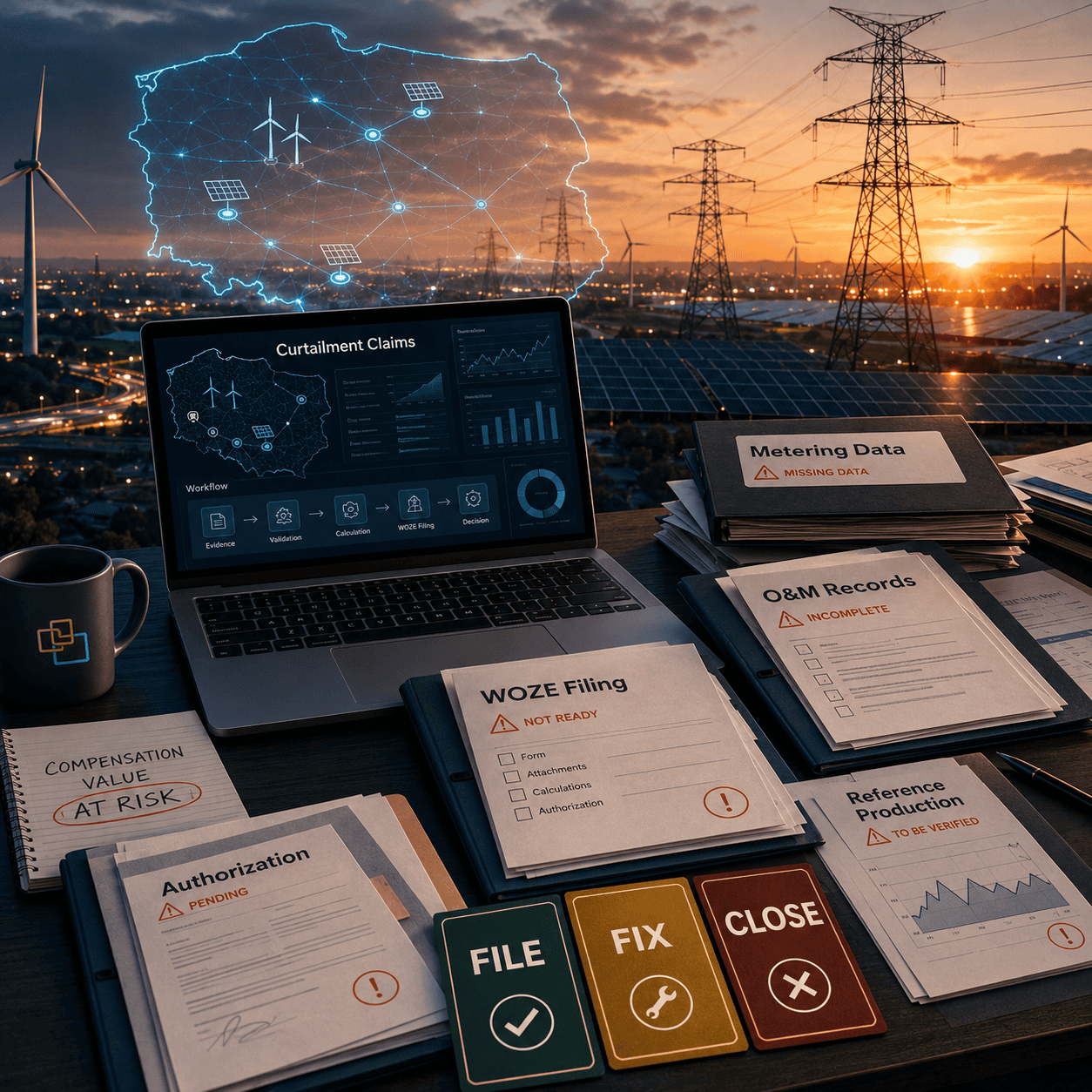
In April 2026 alone, Polish system operators curtailed 344 GWh of large-scale wind and PV output, and the day-ahead market printed 100 hours of negative prices. Since January, the curtailed volume has reached 642 GWh, around half as much again as a year earlier.
For a foreign investor, this is no longer a market footnote. It is a recoverable-value question with four moving parts: which assets were curtailed, what evidence exists, who calculates the claim, and whether the filing package survives Polish verification.
The value is often lost before the system operator reviews anything, at the handover points between legal counsel, O&M, asset management and the person expected to file the claim.
Why this matters now
Every curtailed MWh in Poland may create a compensation question, but compensation rights do not turn into compensation payments by themselves.
The system operator publishes information and procedures for non-market redispatch of Renewable Energy Sources installations. System operator communications state that owners of PV or wind installations that implemented redispatch orders have, as a rule, a right to financial compensation under Article 13(7) of Regulation 2019/943, subject to the applicable Polish rules.
The qualification in that sentence carries the whole risk: a valid entitlement is worthless without a filing package the operator can verify.
For auction-supported assets, timing can also affect value. The system operator’s filing conditions indicate that owners participating in the auction support system should notify the relevant operator within 14 days of the redispatch order if reduced energy should be settled within that support system. Missing that notification can affect the compensation calculation in the part relating to lost auction support revenue.
A simple illustration shows why this matters. A 40 MW wind farm curtailed for 60 hours at an average day-ahead price of 70 EUR per MWh represents roughly 168,000 EUR of gross lost production value before any support-scheme component, methodology adjustment or asset-specific verification. The actual claim may be lower or higher, but the order of magnitude is large enough to deserve a controlled process.
If your Limited Partner (LP) reporting shows curtailment losses without a compensation recovery line, you may already be explaining a loss that could have been assessed.
The misconception imported from Germany
Many international investors assume Poland follows compensation logic similar to Germany’s redispatch framework. That assumption can create a direct operational gap.
What qualifies as sufficient evidence in Germany may be insufficient in Poland. What is automatically available through a system operator process in one market may require manual compilation, validation and authorisation in Poland.
Legal entitlement is only the starting point. The claim stands or falls on the evidence package behind it.
Legal counsel can assess entitlement and structure the claim. The technical burden sits elsewhere: reference production, metering evidence, settlement logic, O&M availability records and the documentation package.
A Polish claim can fail where a German-calibrated process assumes too much. Reference production may be overestimated, metering data may not match the claimed loss, authorisations may be incomplete, or asset-level evidence may not support the figures used in the application.
The filing route is operational, not theoretical
The system operator’s WOZE portal is designed for communication between the Renewable Energy Sources installation owner and the system operator in the compensation process. It covers filing compensation applications, corrections and amendments, monitoring application status, handling applications by the operator, settlement information and complaints at the second stage.
For PV, the system operator states that the WOZE portal is the basic, recommended and expected route for submitting compensation applications. If WOZE cannot be used, a complete application can be sent to redysponowanieOZE@pse.pl, but the operator treats that as an emergency route that may extend processing time.
That means the filing problem is not limited to filling in a form. The investor needs access, authorisation, asset data, metering inputs, O&M evidence and someone who owns the process before the application is submitted.
The 30-page problem
Foreign investors often underestimate the administrative complexity of the process. Once attachments, technical schedules, metering evidence, ownership documents, DSO/TSO authorisations, corporate authorisations and declarations are included, the application package can become a substantial execution task.
Filling in the form is the easy part. Proving the claim in a way that survives formal verification is where the real work sits.
Typical weaknesses before filing
- Inconsistent generation data.
- Incorrect reference production calculations.
- Missing DSO/TSO or corporate authorisations.
- Discrepancies between metering records and reported losses.
- Incomplete evidence of technical availability.
- Translation inconsistencies.
- Unsupported assumptions regarding lost revenue.
- Lack of internal ownership over the filing route.
Individually, these may look minor. In the application process, they can delay settlement, trigger corrections or weaken the claim before the compensation value is even discussed.
The system operator’s own Q&A material for wind applications states that there is no statutory time limit for processing applications and that a high number of errors in submitted applications unnecessarily extends the review and settlement process.
Three mistakes we see in foreign-owned portfolios
1. Treating curtailed energy as the compensation value
The most common error is treating curtailed MWh as the compensation amount. The Polish calculation requires a defensible reconstruction of eligible lost production and value under the applicable rules.
How much energy was curtailed is the easy number. The hard part is whether the reference production, metering evidence and settlement assumptions hold up under the Polish process.
2. Starting the process too late
Many investment teams focus on the curtailment event itself and only later examine the compensation process. By then, internal approvals, data collection, DSO/TSO authorisation and WOZE access may already be consuming the time needed to prepare the filing.
This can be avoided if the process has an owner before the application is drafted. Before assuming that the filing route is ready, check whether the asset is registered in the correct process, WOZE access and user roles are in place, metering and O&M data are available in the required resolution, and corporate and DSO/TSO authorisations are complete.
3. Treating compensation as a legal issue only
Legal review has its place, but recovery is won operationally: in grid data, metering records and settlement analysis, backed by technical validation and disciplined documentation.
Your Warsaw-based lawyer may know the regulation. Your O&M provider knows the turbines or PV plant. Neither automatically owns the space between the operator’s formal requirements and your portfolio’s production data.
Check your O&M SLA. Redispatch compensation recovery is often outside the standard scope. That is exactly where claims fail.
Why international funds are particularly exposed
Domestic developers accumulate institutional knowledge after several redispatch cycles. International investors often do not.
A fund headquartered in London, Copenhagen, Frankfurt or Amsterdam may own multiple Polish assets while relying on local O&M providers, asset managers and advisors for market-specific processes. This structure works well until a compensation event occurs and responsibility suddenly has no single owner.
Questions your team should be able to answer
- Who calculates the claim?
- Who validates the methodology?
- Who confirms technical availability?
- Who prepares the evidence package?
- Who manages WOZE access and filing?
- Who tracks operator follow-up?
- Who updates finance and Limited Partner (LP) reporting?
In many cases, nobody owns the process end to end. The compensation value is lost in the organisational gap between the curtailment event and a defensible filing package.
When the claim is not worth filing
Not every claim deserves a full process, and a serious adviser should say so before the first invoice, not after.
Before preparing a complete application, the investor should run a go/no-go review. The outcome should be one of three decisions: file, fix the documentation, or close the matter before spending more time on it.
A claim may not be worth pursuing if the asset did not implement the relevant redispatch order, technical availability cannot be confirmed, metering data is incomplete, corporate or DSO/TSO authorisations cannot be completed, the expected value is too small, or the connection agreement requires additional legal review before filing.
This is where a technical-operational screen saves time. It prevents the investor from paying for a full filing process when the claim cannot be defended.
How GridLink closes the gap: GridLockdown Rescue
GridLockdown Rescue is GridLink’s execution service for investors facing Polish redispatch and curtailment compensation.
The service is designed around the operational layer that legal advisors, O&M providers and asset managers often do not own. It covers the work needed to move from a curtailment event to a filing package that can be reviewed under the Polish process.
A strategy consultancy will map the risk and a law firm will frame the entitlement; neither will reconstruct reference production hour by hour against PSE’s verification logic.
We start with the question that matters most: is the claim worth filing? GridLink checks whether the asset appears eligible for a compensation review, what data is available, whether reference production can be reconstructed, whether metering and O&M evidence support the claim, which authorisations and attachments are missing, and whether the application package is ready for WOZE or needs further work.
We spend the first 48 hours on one decision: can this claim be defended? Drafting the full application comes later, and only if the answer is yes.
If the claim is worth pursuing, GridLink prepares the execution layer: claim value assessment, documentation gap analysis, reference production reconstruction, metering and O&M evidence review, application package preparation and support through operator follow-up.
In our review process, investor-prepared documentation is checked against the operator’s formal requirements before filing. Most weaknesses appear before submission: incomplete metering evidence, inconsistent reference production, missing authorisations or unclear responsibility for the filing route.
What to do before you file
If your Polish wind or PV assets were curtailed in 2026, start with a go/no-go review before opening a full application process.
Before the filing route is opened, the asset team should be able to answer five questions: which assets were curtailed and on which dates, who holds the metering data and in what resolution, who can confirm technical availability for the curtailed periods, who can reconstruct reference production under the Polish methodology, and who owns WOZE access and operator follow-up.
If you cannot answer these questions without calling three different advisers, that gap is where your claim currently sits.
There is no statutory deadline forcing the system operator to process a weak application, which means a poorly evidenced claim does not fail fast; it drifts. Meanwhile metering data ages, O&M records scatter across providers, and any auction-scheme notification window keeps running. The decision to file, fix or close does not require a full application. It requires a structured look at the data, and that takes two days.
Not sure what your Polish curtailment is worth?
Not ready to share asset-level data? Run the five-question triage internally first: which assets were curtailed, who holds the metering data, who can confirm technical availability, who can reconstruct reference production under the Polish methodology, and who owns the filing route. If any answer requires calling three advisers, that gap is where your claim currently sits.
Send asset capacity, curtailment dates, the relevant operator, the status of metering and O&M availability records, and whether WOZE access is in place to biuro@gridlink.pl.
Within 48 hours you will receive an initial compensation view, the main documentation risks and a clear recommendation: file, fix the documentation or close the matter.
If any of your assets settle under the auction support system, start today. The 14-day notification window does not wait for internal approvals.
Where the review requires production files, settlement data or commercial documentation, we sign an NDA before receiving anything.
Source note: market data is based on Forum Energii’s April 2026 Monthly Magazine. Procedural references are based on system operator, DSO and TSO materials concerning WOZE, PV filing routes, filing conditions for compensation applications and operator Q&A material on application processing.