Your target’s connection agreement or connection condition looks clean on paper. Whether it survives the UC84 milestone clock is what decides if you bought an asset or a countdown. Legal due diligence will not tell you the difference.
On April 1, 2026, Germany changed how its transmission grid hands out connection capacity. For battery storage and large consumers, the transmission operators dropped first come, first served and moved to a maturity ranking called the Reifegradverfahren, where projects that can prove they are real get priority over projects holding a place in the queue. The first cycle is running now, with applications due by 30 June and binding offers expected by the end of November.
Poland moved in the same window but took a different route. The act known as UC84 was signed on 2 April and entered into force on 30 April 2026. It left the queue order largely in place and tightened the deadlines instead. That looks like the smaller reform. For a fund buying Polish Renewable Energy Sources or BESS assets, it is the one that can quietly turn a signed agreement into a stranded one.
A standard legal due diligence built on pre-UC84 assumptions will not catch this. It reads the connection agreement or connection condition, confirms it exists, and stops there. What it does not test is whether the project can clear the milestone the operator will enforce next, which is the thing that decides whether the connection survives.
The benchmark: Reifegradverfahren next to UC84
Germany now ranks projects by readiness. An SPV sitting on a connection node with no operational progress loses its place to a project that can show secured land, a live permitting track, a sound technical connection concept, and the financial standing to build. The operator scores those criteria and weights them.
How Germany weights maturity
- Site control and permitting status: 30 percent
- Technical plant and connection concept: 30 percent
- Economic capacity of the applicant: 30 percent
- Grid and system benefit of the project: 10 percent
If more projects apply for a power node than there is capacity, the highest scores get the offer and the rest wait or drop out.
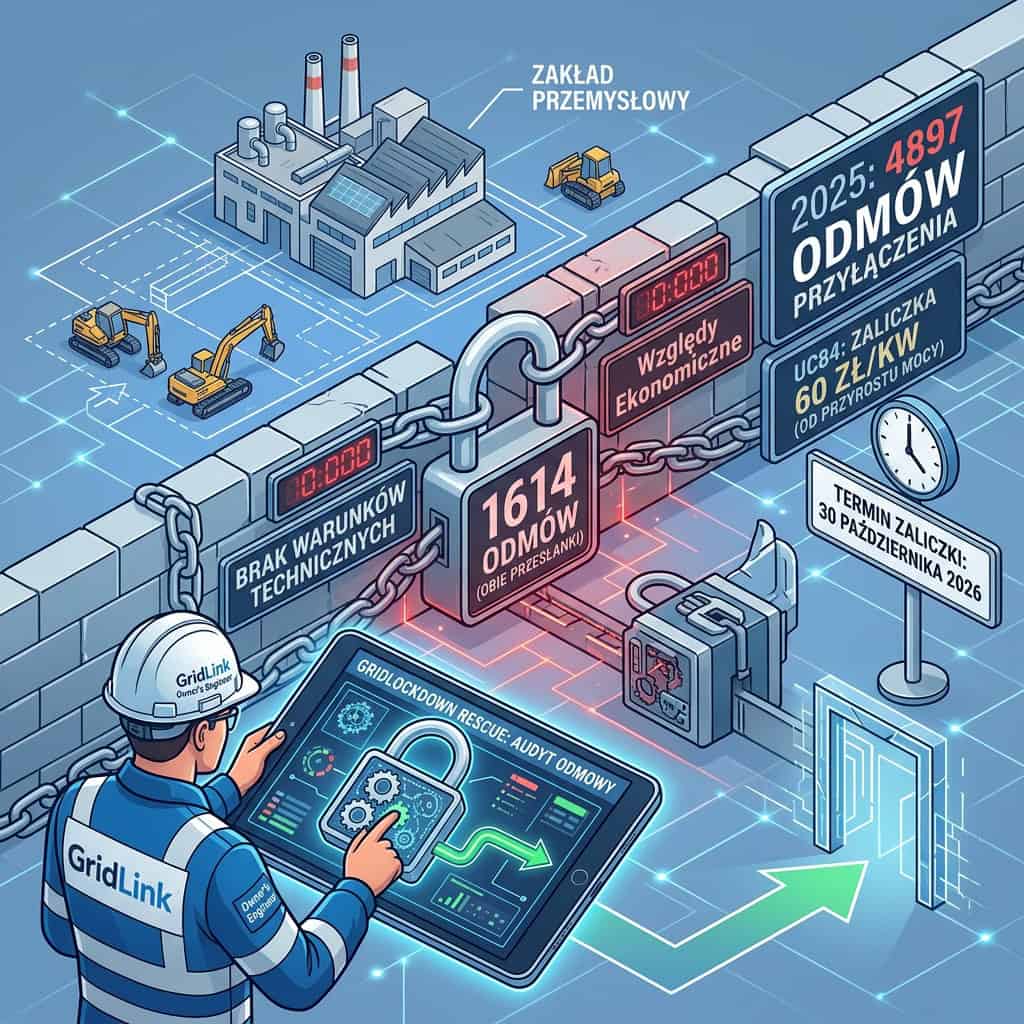
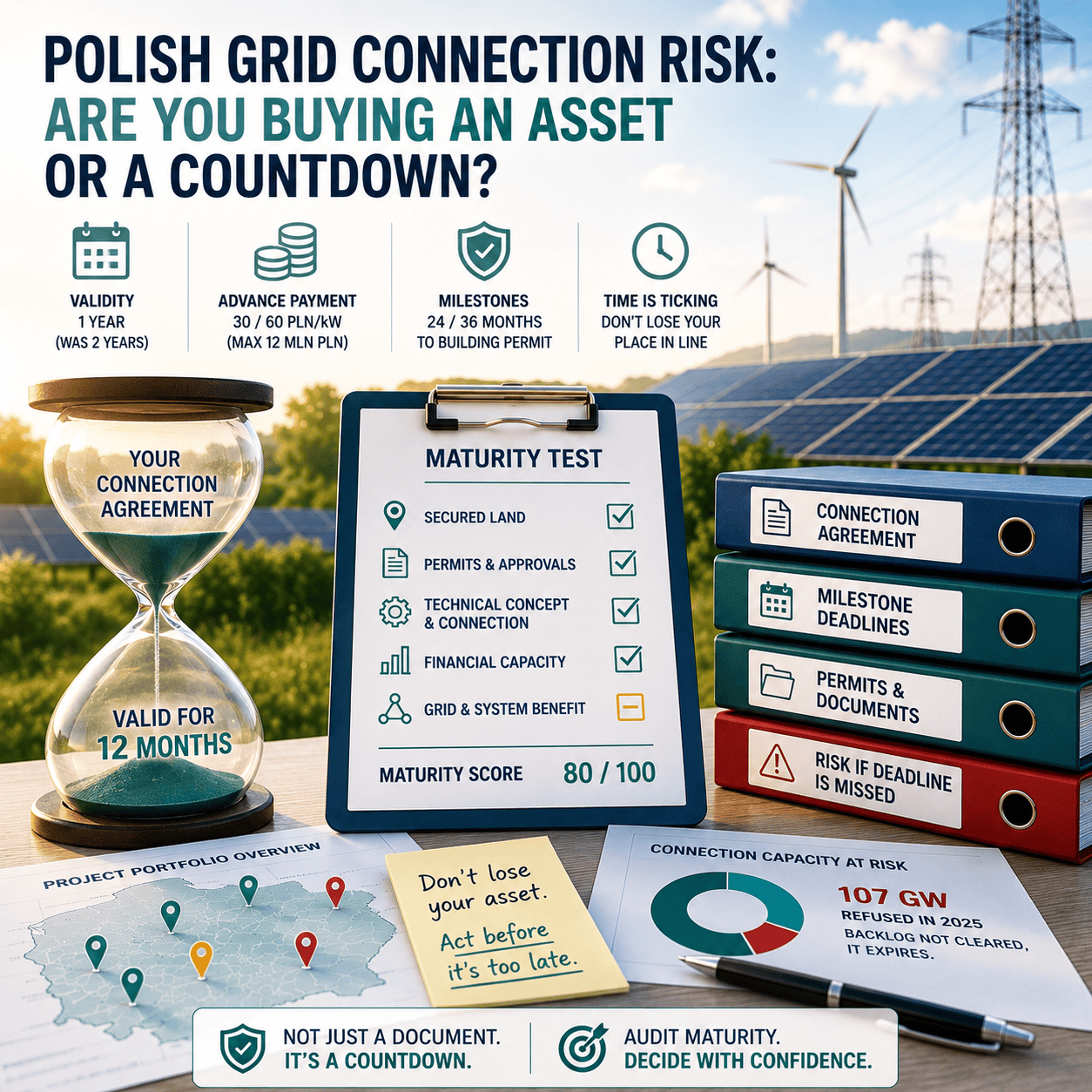
Poland took a narrower path. Facing a record 107 GW of refused connection capacity in 2025, up from 73.6 GW the year before, the legislator tightened the milestones and left the queue order mostly intact. The one exception is a limited capacity competition that only the transmission operator can run, only between 2026 and 2028, and only at a handful of substations. For everyone else the order does not move. Instead of reordering by readiness, the Polish system clears the queue by attrition. Undercapitalized or mismanaged SPVs miss their UC84 deadlines and fall out on their own schedule.
That half step is where the opportunity sits. Because UC84 did not clear the queue overnight, the market is full of SPVs holding connection conditions that are already exposed, projects that cannot realistically hit the new deadlines, while still looking on paper like a normal acquisition target.
What this actually costs you
Here is the failure mode in plain terms. A fund closes on a 40 MW Polish wind SPV on the back of a clean legal opinion and a valid-looking connection agreement. The clock it inherited is the building permit deadline. Under UC84 a connection condition expires by operation of law if the project does not reach a final building permit in time, with 24 months for PV and storage and 36 months for wind and biogas.
If that deadline passes unmet, the agreement lapses and the reserved capacity returns to the pool. The fund is no longer holding a delayed project. It is holding a power node with no permit, no time, and no buyer, because anyone running real diligence will see the same gap.
That is not hypothetical. Across the Polish SPVs GridLink has reviewed, a significant share could not produce the physical and administrative progress evidence the milestone regime now requires, which means their agreements are already at risk of termination, whatever today’s paperwork suggests.
When to fight, when to walk
Not every gap is fatal, and not every distressed SPV is worth rescuing.
Worth the fight. Land control is substantively secured but the documentation is incomplete, permitting is delayed but active, or the gap is administrative rather than physical. These are usually recoverable with the right regulatory move inside one deadline cycle.
Walk away. No land control, no permitting activity, or a sponsor who has already let deadlines slip more than once. At that point there is no project to rescue, only a failure to finance.
The expensive version of getting this wrong is not the failed asset. It is the weeks of exclusivity and legal spend you burn before you find out.
The playbook
Two moves change the outcome.
First, price the operational maturity, not the queue ticket. A connection condition confirms the project is in the queue and says nothing about whether it survives the next checkpoint. Audit the underlying evidence, meaning land, permits, and construction progress, before you price the deal rather than after the wire clears.
Second, audit against UC84, not the standards that applied before it. Every target has to be stress tested against the milestone rigor in force from 30 April 2026. A pre-UC84 template will pass projects that are already finished.
Where standard due diligence stops and GridLink starts
A law firm or a Big4 advisor confirms that the agreement exists and the corporate structure is clean. They do not verify whether the land rights, permitting status, and construction progress actually meet the maturity bar a DSO or TSO will check at the next deadline. That is a technical and regulatory read, and it is the read that tells you whether your capital is going into a project that survives or one that is already lapsing.
GridLink works on two fronts.
GridLink reliance letters. For an acquisition, we issue technical and regulatory reliance letters that assess, in writing, whether the connection can clear the UC84 milestone regime and what it would take to get there. You get a reasoned opinion you can rely on in the deal, naming the specific gaps and the work to close them, before you commit capital.
UC84 rescue operations. For a portfolio already exposed to a tightening deadline, our engineering and regulatory teams build a recovery path, renegotiate terms where the rules allow, and work to secure the connection before the agreement lapses.
The 107 GW that operators refused in 2025 is a record, and the backlog is not clearing through reform. It clears one missed deadline at a time, and every agreement that lapses hands capacity and leverage to the projects still standing.
The funds that ask whether a target clears the UC84 milestone bar before they bid will be the ones left at the table when the bidding gets serious. The rest will run this diligence after the wire has cleared, when the only thing left to negotiate is the write-down.
Find out whether your target survives, before you commit
Not sure whether your target clears the UC84 milestone bar? Send us the connection condition and the current permit or agreement status, and you will have a written read on whether it survives within 5 business days. No engagement required, and everything you share is covered by NDA. The statutory deadline will not move to fit your deal timeline.
Already holding a Polish portfolio with a building permit deadline inside the next 12 months? Start a UC84 Rescue Assessment this week. Every week of delay shortens what can still be renegotiated with the DSO or PSE before the agreement lapses.