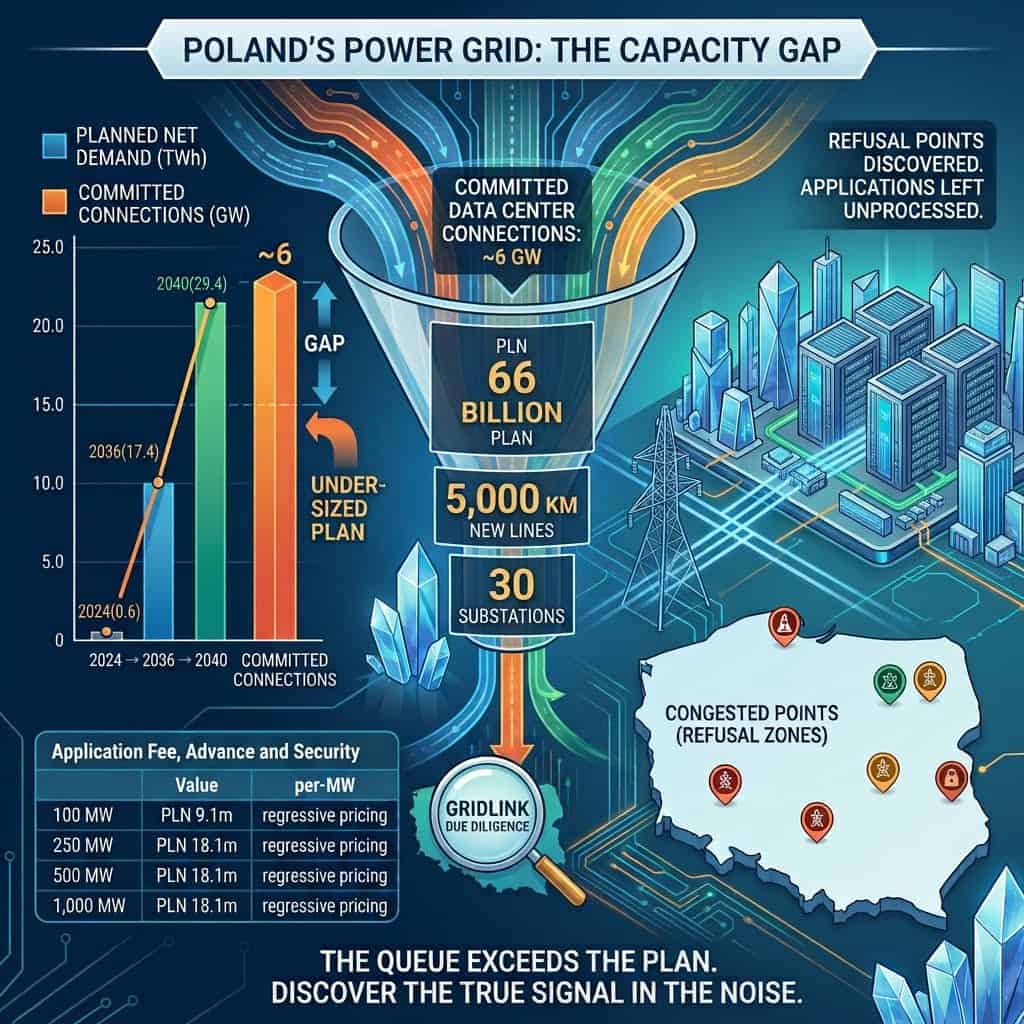
PSE’s transmission plan for 2027 to 2036 leads with PLN 66 billion. The plan it replaces, agreed by the regulator on 20 December 2024, carried PLN 64 billion, 4,700 km of new 400 kV line and 28 new substations. The new one carries 5,000 km and 30. Two editions apart, that is 300 km of extra line, two extra substations and PLN 2 billion, while the load the same network is being asked to absorb grew a great deal faster. That gap is what a Polish site shortlist runs into, and it does not appear in any of the coverage.
Most write-ups take the headline number and stop there. For anyone selecting industrial, data centre or generation sites in Poland, what sits inside the document, along with one file published alongside it, matters far more than PLN 66 billion.
What the plan assumes about a load like yours
Table 4.3 of the post-consultation document, dated April 2026, sets out the data centre demand PSE planned around. In 2024, 200 MW and 0.6 TWh, sourced to the Polish Data Center Association. By 2036 the plan carries 3,093 MW and 17.4 TWh, and by 2040, 5,018 MW and 29.4 TWh.
Run the arithmetic on the 2036 row. Dividing 17.4 TWh by 3,093 MW gives about 5,600 hours, a load factor near 64 percent. That is the operator’s working assumption for how hard this class of customer will actually pull, and it is a good deal more conservative than the flat-out figure a developer will put in a business case.
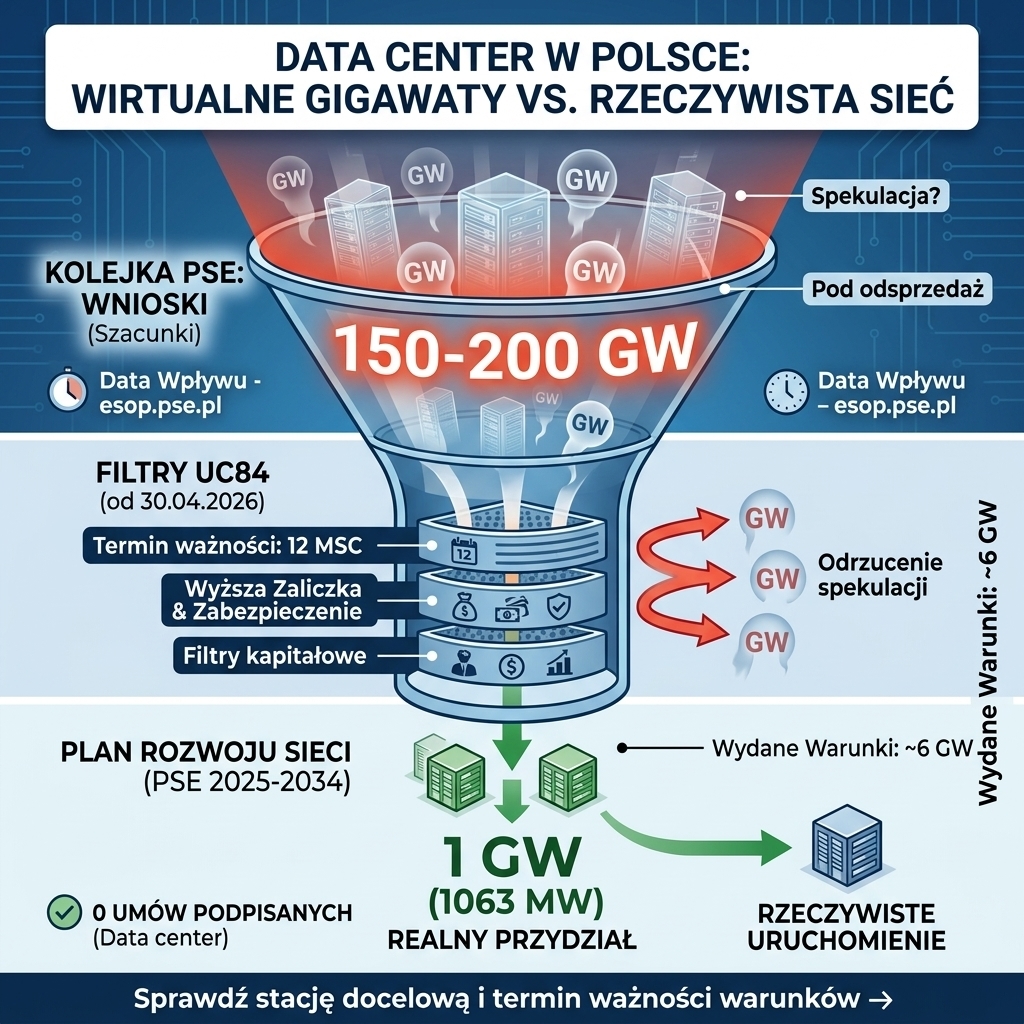
Now set that against the paper already issued. PSE has granted connection conditions to data centres totalling roughly 6 GW. The commitments on paper are close to double what the network plan carries for 2036 and sit above its 2040 figure, and very few of them have been converted into signed connection conditions. Anyone shortlisting a site in Poland is joining a queue whose paper claim already exceeds the plan sizing it.
The file that settles a shortlist question in a minute
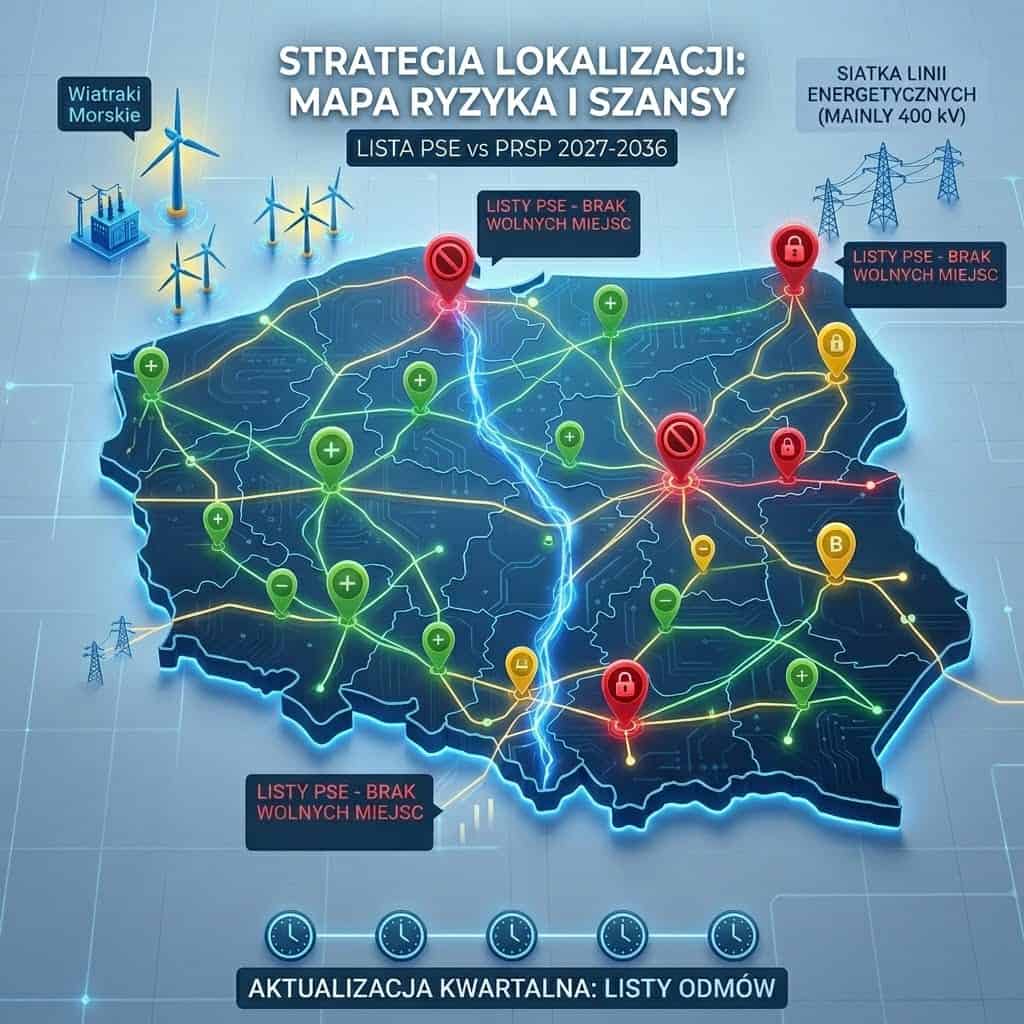
On 4 February 2026, two days after releasing the draft plan, PSE updated a separate document that almost nobody outside the process reads. It lists the switchgears and connection points (GPZ) with no available connection points.
The current version shows 37 of them across 33 existing stations, with Gdańsk I appearing at all three voltage levels. The 400 kV busbars at Chełm Systemowa, Mościska, Ostrołęka and Wrocław are on it. PSE spells out the consequence. An application to any of them is answered with a refusal to issue connection conditions, on technical and economic grounds, and the file is never examined. A further 30 switchgears sit in planned stations where the realisation is conditional, undecided, or where PSE will not be the owner. Applications there are left unexamined and unprocessed, as are applications to line cut-ins on the highest-voltage network.
The legal instrument sits inside the plan itself
Article 16(81) of the Polish Energy Law allows a network operator to designate, in its development plan, areas where new installations above 1 kV cannot be connected. Such an area covers at least one switchgear, existing or planned, and the operator must state the grounds and the conditions under which that status could change. Article 7(82) sets out what happens to an application filed inside one: it is left without consideration. A single exception survives, under Article 7(1h), covering the addition of a further installation or storage unit at an existing connection point and changes to technical parameters that do not increase connection capacity. In practice that is cable pooling, and in a closed area it is the only route that still gets examined.
This clause has teeth. Everything else in the plan is a statement of intent about the next decade, revisable at the next edition. This one turns a line in a planning document into a bar on filing at all.
What it costs to find out the hard way
UC84, the network act of 13 March 2026, has been in force since 30 April 2026. It sets three charges on any application above 1 kV. The application fee is PLN 1 per kW, capped at PLN 100,000, non-refundable, and payable separately for each connection point named in the application (Art. 7(8b1)). On top of that comes an advance against the connection fee, PLN 60 per kW capped at PLN 6 million, which has to reach the operator within 14 days or the application is left unprocessed (Art. 7(8a) to (8c)). Security runs at PLN 30 per kW up to 100 MW and PLN 60 per kW above that, capped at PLN 12 million (Art. 7(8c1)).
Every element is capped in absolute terms. That produces a result the drafters presumably did not intend, because the effective cost per megawatt falls as the application gets bigger.
| Application | Fee, advance and security | Per MW |
|---|---|---|
| 100 MW | PLN 9.1 m | PLN 91,000 |
| 250 MW | PLN 18.1 m | PLN 72,400 |
| 500 MW | PLN 18.1 m | PLN 36,200 |
| 1,000 MW | PLN 18.1 m | PLN 18,100 |
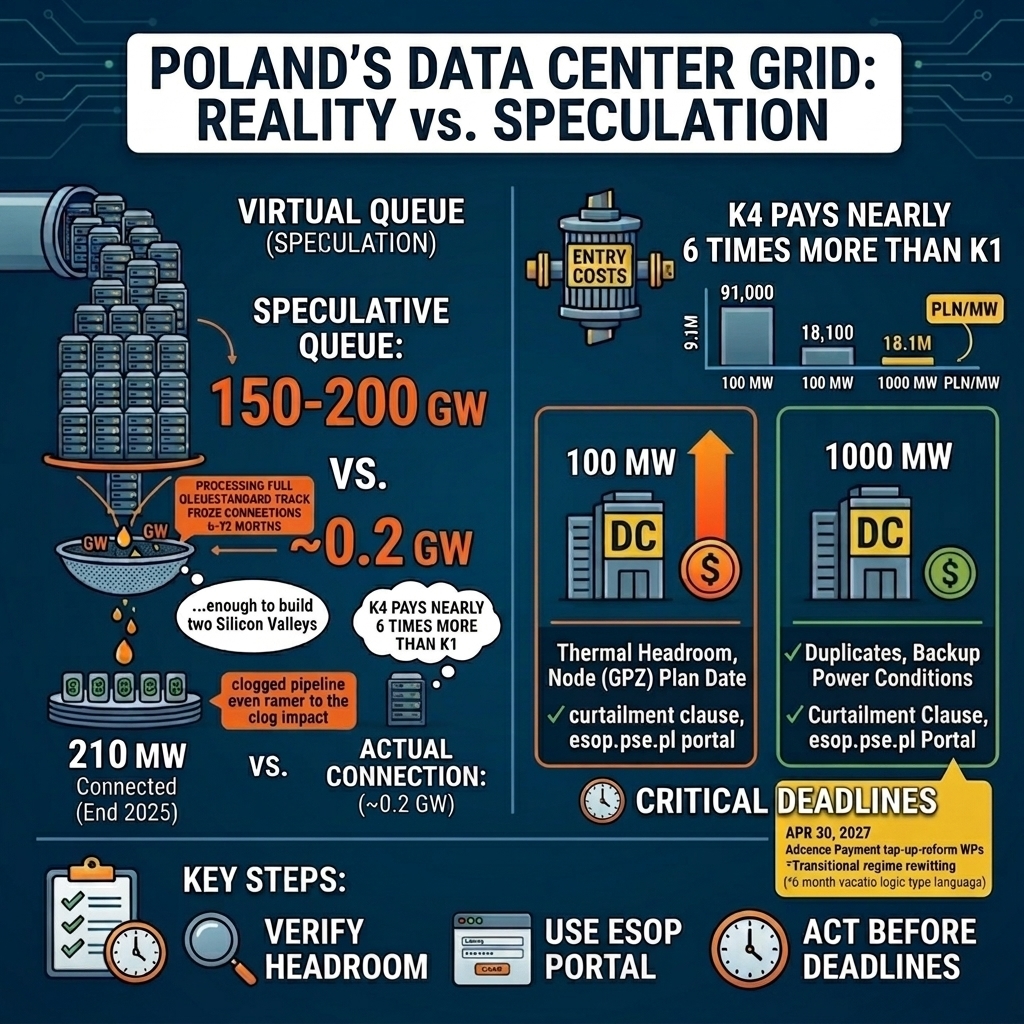
The capital filter built to price speculative gigawatt applications out of the queue is five times cheaper per megawatt for them than for a serious 100 MW project. Three separate 800 MW applications at three nodes come to PLN 54.3 million for 2.4 GW, which is PLN 22,625 per MW. None of that money buys a connection. It buys the right to have the application examined, and on a switchgear from the 4 February list the application fee is spent on a refusal that was decided before anyone opened the file.
The deadline that applies to an industrial load
Every English-language summary of UC84 lists 24 months for solar and storage and 36 months for wind and biogas. That list is incomplete. An industrial load or a data centre sits under a different line of the same provision. Article 7(2a)(1)(b) gives 24 months from signing the connection agreement to a final building permit covering at least 50 percent of the installed capacity under that agreement, and where the receiving equipment goes inside a building, the permit that counts is the one for the building. Miss it and the agreement expires by operation of law.
Two details decide whether that is comfortable or tight. The clock starts at the connection agreement, not at the conditions, which is where most schedules are anchored in conversation. And the term can be extended once, by up to 24 months, at the price of a further security of PLN 60 per kW capped at PLN 12 million (Art. 7(2h) and (2i)). On a 200 MW load that extension costs the full PLN 12 million.
Poland against the alternatives
Funds looking at Poland are usually looking at the Netherlands and Ireland in the same week, so the comparison deserves numbers.
TenneT holds 212 active requests for offtake capacity from large consumers, totalling roughly 38 GW. Dutch peak load is around 20 GW. The queue for large-consumer offtake alone is therefore close to twice the entire national peak, which is the figure that gives 38 GW its meaning. In April 2026 a court in Arnhem dismissed a data centre developer’s claim against TenneT over the Vijfhuizen substation in Haarlemmermeer, near Schiphol, finding that the grid in that region is genuinely full. Constraints there are expected to run to around 2035.
Ireland reopened connections after a five-year moratorium, on terms: 80 percent renewable supply within six years and 100 percent on-site backup generation. Dublin stays closed until 2028. In Germany, 50Hertz operates a project maturity procedure with a EUR 50,000 fee attached.
Read together, these put the Polish regime in the middle of the European pack. The direction of travel is the same across the continent, and Poland at least still has corridors under construction, while Noord-Holland is looking at a decade with no extra room. What it does differently, to an investor’s advantage, is publish the station-level list.
What this looks like in practice
GridLink runs owner-side technical due diligence on Polish grid connection points before capital or legal spend commits to a location. We check the candidate / project lovation against the switchgear list and connection point and the quarterly filings for that specific station, against the corridor programme in the plan, and against the UC84 regime that will apply to that class of project at the stage it is actually at. The engineering side is led a team that has over 800 MVA connected to the operator’s network.
We produce analyses, reviews and reports on the owner’s side and flag risks and recommendations. We do not replace the designer and we do not guarantee the outcome of a connection procedure, which nobody who has sat through one would offer to do.
One caveat that works against us. If the switchgear you are targeting is on the 4 February list, no amount of due diligence changes that answer and there is nothing there worth commissioning. That conversation takes fifteen minutes and costs less than the application fee.
Send us a station symbol or a voivodeship area. We will tell you whether that switchgear is on the list and what the latest quarterly filing shows for it. No engagement, no documents needed.
If you are shortlisting Polish sites now, or reviewing a shortlist someone else built, send the candidate locations under NDA. The previous edition took nine months from draft to regulator agreement, 15 March 2024 to 20 December 2024. The same interval measured from 2 February 2026 lands in early November. Once the plan is agreed, the corridors and the designated areas stop being a forecast and become the baseline every counterparty is working from.
Sources: PSE announcements of 2 February 2026 and 2 January 2025; PRSP 2027-2036 main document, post-consultation version, April 2026, Table 4.3; PSE list of switchgears with no available connection points, 4 February 2026, and the quarterly connection filings at pse.pl; Polish Energy Law, Articles 7 and 16, consolidated text Dz.U. 2026 item 43; Act of 13 March 2026 amending the Energy Law, Dz.U. 2026 item 516; TenneT; NL Times reporting on the Arnhem ruling of April 2026.