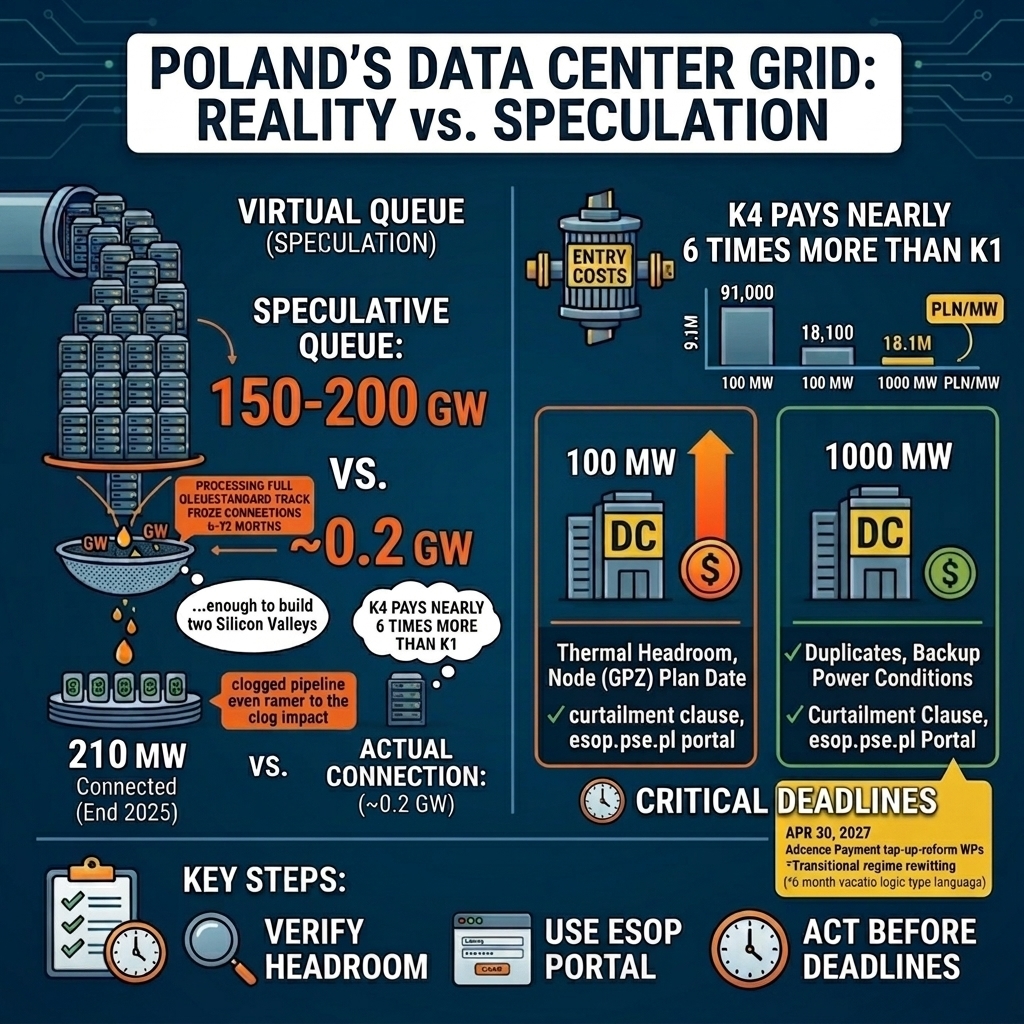
Poland’s operating data centre fleet passed 210 MW at the end of 2025. The connection queue held by the transmission operator, PSE, is estimated at 150 to 200 GW. PSE has issued formal connection conditions, warunki przyłączenia or WP, for about 6 GW of that, and has not yet signed a single connection agreement with a data centre. The 2026 reform was written to price speculators out of that queue. Run the numbers on what it charges and a 1,000 MW filing costs 18,100 PLN per megawatt of reserved capacity while a 100 MW filing costs 91,000. The filter is five times cheaper for the filings it was aimed at.
The number that is not the number you think it is.
Distribution system operators (DSO) sit further ahead in count, if not in scale. Energa-Operator holds conditions for 19 data centre projects totalling 1,211 MW, five of them carrying an additional 405 MW of backup power conditions. Stoen Operator in Warsaw has issued conditions for more than 300 MW on top of 12 connected sites drawing around 160 MW of contracted capacity, with agreements signed for a further 500 MW.
None of those working figures resembles 150 to 200 GW. That gap is where the underwriting risk lives. Marek Duk, who directs PSE’s system development department, has said publicly that processing the full queue on the standard track would freeze new data centre connections for six months to a year, because a large share of the filings are not construction projects. Applications for 500, 800 and 1,000 MW blocks, filed by entities with no record of building at that scale, read as capacity reservations built to be resold once Poland’s shortage makes the paper valuable on its own. When the queue stood at a still startling 40 GW, PSE’s president joked it was enough to build two Silicon Valleys. It has grown four to five times beyond that joke since.
A WP in a data room confirms one thing. Somebody filed, and the operator processed the filing. It says nothing about the money behind the project or any intent to energise a rack. Underwriting a site on the strength of a WP alone means underwriting the noise in the queue and calling it signal.
What entry costs, and why the filter runs backwards?
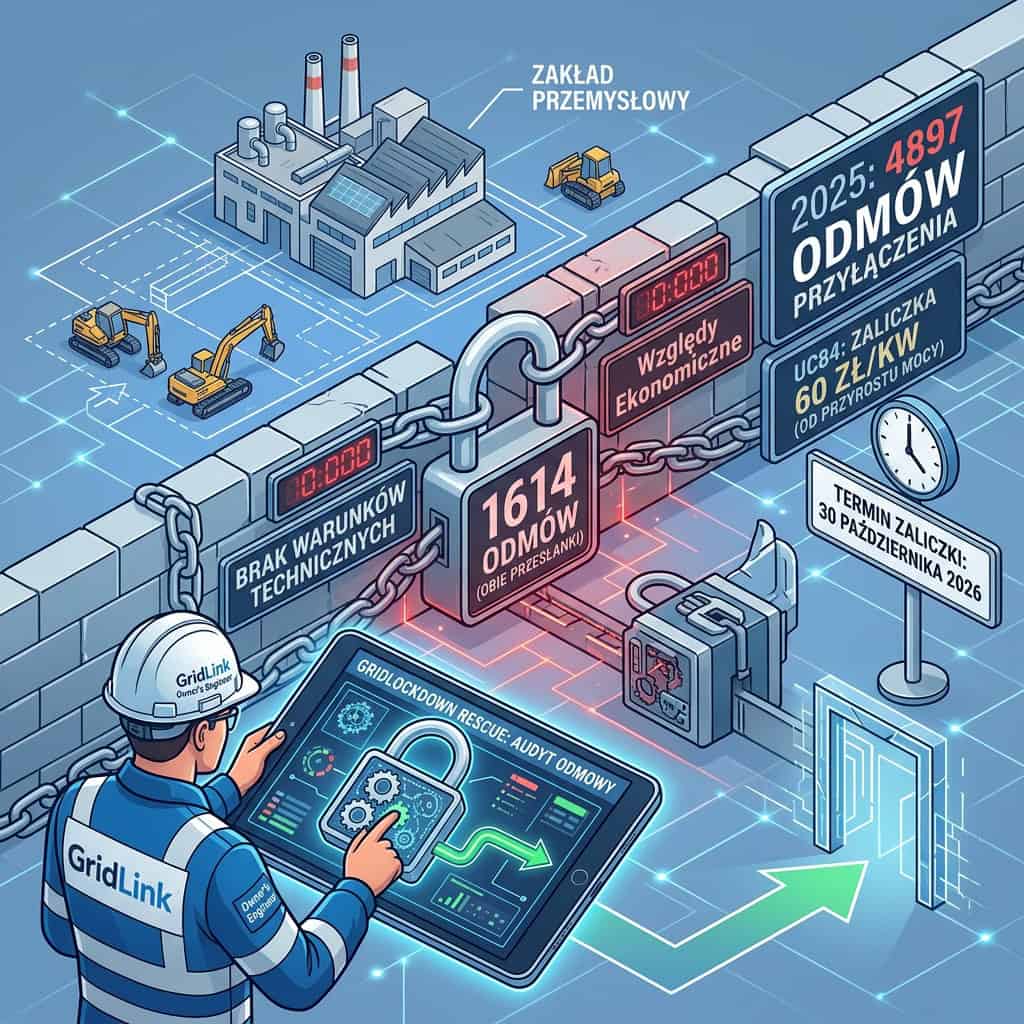
The act of 13 March 2026, in force since 30 April 2026, put three charges on every connection application above 1 kV. A non-refundable application fee of 1 PLN/kW capped at 100,000 PLN. A connection advance, zaliczka, of 60 PLN/kW capped at 6 million PLN, doubled from 30. A security deposit, zabezpieczenie, of 30 PLN/kW on the first 100 MW and 60 PLN/kW above that, capped at 12 million PLN.
Every one of those caps arrives early. The fee and the advance top out at 100 MW. The deposit tops out at 250 MW, because the first 100 MW contributes 3 million and the remaining 9 million buys 150 MW at the higher rate. Above 250 MW the total stops moving.
Cost of entry by filing size, in PLN
| Filing | Total at filing | Per MW | Deposit if uncapped |
|---|---|---|---|
| 100 MW | 9,100,000 | 91,000 | 3,000,000 |
| 250 MW | 18,100,000 | 72,400 | 12,000,000 |
| 500 MW | 18,100,000 | 36,200 | 27,000,000 |
| 1,000 MW | 18,100,000 | 18,100 | 57,000,000 |
Carrying cost, if the deposit and advance sit for the full 24 month milestone period: about 362,000 PLN for every percentage point of your cost of capital.
The right hand column is the one to sit with. A 1,000 MW reservation would cost 57 million PLN in deposit alone if the cap did not exist. It costs 12 million because it does. The cap was written to protect legitimate large projects from a punitive number, and its practical effect is that reserving a gigawatt of Polish grid capacity is the cheapest thing in the table on a per megawatt basis.
For a developer with one 100 MW campus and a signed offtake, the reform bites at full strength. For an entity filing three 800 MW blocks at three different nodes, it costs 54.3 million PLN to hold 2.4 GW, which is 22,600 PLN per megawatt. Draw your own conclusion about which behaviour the pricing discourages.
The transitional provisions are where the deadlines hide.
This is the part of the reform most foreign investors have read second hand, and it is the part being rewritten right now.
Connection Conditions determined from 30 April 2026 onward run on a one year clock, down from two. Conditions determined earlier keep the original two year window, which is where the reassurance usually stops. It should not. An investor holding a WP issued before 30 April 2026 who has not yet signed a connection agreement has twelve months from that date, so until 30 April 2027, to pay or top up the zaliczka to the new level. The longer validity window protects nothing if that deadline passes.
There is a second date. Part of the transitional regime carries its own six month vacatio legis and takes effect on 15 October 2026. The drafting proved ambiguous enough that a corrective amendment is now moving through the Sejm’s Deregulation Committee, replacing the phrase day of entry into force with specific dates. Until that closes, which clock a given WP runs on is a question for the file, and no published summary settles it.
Milestones, and what a data centre has to prove.
Milestone deadlines run from signature of the connection agreement. Twenty four months for PV and energy storage, thirty six for wind and biogas, sixty for railway infrastructure. A data centre is a consumer connection and sits under the twenty four month heading. Miss the milestone and the agreement expires by operation of law, releasing the capacity back to the pool.
The proof required differs by category, and this is where summaries go wrong. A generation project must show a final building permit covering at least 80 percent of the installed capacity written into the agreement. A consumer connection must show a final building permit covering at least 50 percent of the connection capacity. Neither test asks whether anything has been built. Both ask for a permit, and permitting is the part of a Polish data centre programme that the investor controls least.
The milestone can be extended by up to twenty four months. The price is additional security of 60 PLN/kW capped at 12 million PLN, and that cap arrives at 200 MW. So a 500 MW campus that needs the extension has 30.1 million PLN posted in total, and a 100 MW campus that needs it has 15.1 million, which is 151,000 PLN per megawatt against 60,200. The regressivity holds all the way through.
Two procedural points sit alongside the money, both in force since 1 August 2025. PSE processes modification requests outside normal queue order where they change equipment manufacturer, type, element count or unit parameters without raising connection capacity or maximum generated power. Separately, a defective application can be corrected within 14 days of the notice while keeping its original filing date, though the review deadline extends by the days between notice and correction. Since 1 July 2026 all new applications go through PSE’s ESOP portal at esop.pse.pl. Earlier filings stay valid, but registration in the Business Partner Portal is a separate process to finish before you file. Starting it on filing day pushes your date of receipt, and date of receipt is the one position in this queue nobody can recover for you.
Where Poland sits on the European curve?
None of this is a Polish anomaly. It is an early position on a curve that two other markets have already travelled, and both of those markets show what the destination looks like.
In the Netherlands, TenneT’s offtake waiting list runs to 212 requests totalling 38 GW. In early 2026 the operator told a number of companies in the Schiphol region that their connection requests were paused, with capacity constraints in the area potentially persisting to around 2035, and a Dutch court confirmed in April 2026 that the grid in Haarlemmermeer is full and a data centre connection had to wait. The Dutch answer to congestion is contractual. Capacity is sold with conditions attached to it. ATR85 guarantees contracted transport capacity for 85 percent of the hours in a year, leaving the remaining 15 percent at the operator’s disposal. Time bound transmission rights, authorised by the regulator in 2025, sell capacity in defined windows.
In Ireland, the regulator reopened data centre grid connections in early 2026 after a moratorium running since 2021, and attached conditions to the capacity it released. New data centres must reach 80 percent renewable supply within six years and carry 100 percent on site backup. Dublin, where data centres draw roughly half of regional electricity demand, remains under a de facto moratorium anyway, with EirGrid signalling no new applications there before 2028.
Poland’s own reform already contains the seed of the Dutch model. The 2026 act introduced a flexible and configurable connection agreement. For a generator that is a tool for getting into the grid sooner. For a data centre selling availability in nines, a clause permitting the operator to curtail offtake is a contractual exposure of a different order from the 18.1 million PLN of entry cost, because the entry cost is bounded and an SLA penalty is not. The question to ask before signature is specific: in which system states may the operator restrict offtake, for how long, on what notice, and with what compensation. That answer lives in the agreement and in the conditions attached to it. A verbal assurance from the operator is not a reference point.
Where the capacity is coming from?
About 74 percent of Poland’s operating data centre power sits in and around Warsaw, on roughly 70 percent of the country’s commercial colocation floorspace. Stoen puts current peak demand for the city at about 1.4 GW, doubling to 2.8 GW by 2030. A single 1,000 MW campus application is close to three quarters of what the entire capital draws at peak today, filed by one applicant, at stations never sized for that concentration.
The more interesting near term capacity is appearing elsewhere. Tauron has named five sites on its coal era grid infrastructure at Jaworzno, Blachownia, Łaziska, Siersza and Bielsko-Biała, releasing 440 MW by 2035, with first sites operable between 2027 and 2029. On the Baltic coast, WBS Power’s Choczewo campus is planned in four 800 MW stages toward 3.2 GW, sequenced against the offshore wind buildout and the planned nuclear plant nearby. Both of those priced the grid before they priced the concrete. Speculative filings run the other way round.
PSE moved its own forecast, and the way it moved is the tell.
Compare two consecutive editions of PSE’s transmission development plan and you can watch the operator change its mind about what a data centre is.
The 2025 to 2034 plan allocated 1,063 MW to data centres by the end of the decade against 9.3 TWh of annual consumption. Divide one by the other and you get 8,760 hours, a full calendar year at nameplate. PSE was modelling data centres as continuous load at 100 percent utilisation. The 2027 to 2036 plan raises the outlook to more than 3 GW connected by 2036 and more than 5 GW by 2040, with consumption above 17 TWh and 29 TWh respectively. Run the same division and implied utilisation falls to roughly 65 percent.
In one plan cycle the operator nearly tripled the capacity it expects to connect and softened the load profile it expects to see. Delivering that scale depends on roughly 5,000 km of new 400 kV circuits, 30 new stations and the rebuild of 110 existing ones, priced at close to 66 billion PLN over the decade. A site that needs a slice of that new infrastructure inherits a system level investment cycle measured in years. A local upgrade is measured in months. Knowing which one your station needs is worth more than any national queue figure.
Reading the queue at your own station.
The national number tells you almost nothing about your odds at a specific 400/110 kV station in a specific voivodeship. The local picture tells you a great deal.
What to check at your specific node
How much of the station’s remaining thermal and short circuit headroom is already allocated to somebody else. Capacity promised to a neighbour is as unavailable as capacity already drawn.
How many filings ahead of you at that node carry the profile PSE has flagged: large block, no build history, no visible financing.
Whether your target GPZ appears on PSE’s published list of stations at capacity, and whether it appears in the development plan with a date attached.
Whether the entity holding the WP intends to build, or is positioned to sell the paper on.
Backup power supply. It needs its own connection conditions and its own line in the node’s power balance, and it is the item most often missing from a filing.
The curtailment clause. In which system states the operator may restrict offtake, and what that does to the availability figure in your customer contract.
PSE has publicly confirmed it is finding investors filing duplicate applications for the same physical project at different connection points, purely to improve queue position. Two healthy looking WPs in a data room can therefore describe one real project and one that was never going to compete for the same grid capacity.
No single check should kill a site. An applicant with no construction history at that scale, a station already on PSE’s list, and a WP past its validity window with nothing signed behind it, all on the same file, usually do. The reverse combination is the one worth moving capital on before somebody else does: confirmed headroom at the node, financing or an EPC contract in place, a WP early in its validity window, and a clean payment , zaliczka position under the transitional rules.
What we check before you sign
We work the connection condition file the way an owner’s engineer works a construction contract, as the document that governs risk, cost and schedule regardless of what the broker’s deck says about the site.
Verifying a station’s real remaining capacity sounds like one task. It is four. We set the operator’s published list of planned connections against what has already been issued to others at the same node. We check whether the power station appears in the development plan with a date, or only in conversation. We compute the node’s power balance including backup supply. Then we put the result next to what the operator said verbally and show the difference, together with what that difference does to your energisation date.
Alongside that we read the applicant history at the node against PSE’s duplicate filing findings, model the payment, zaliczka and cash security, zabezpieczenie against your milestone dates including the cost of an extension, and price the curtailment clause against the availability you have committed to your customer.
Two dates for your investment committee
If your Connection condition was determined before 30 April 2026 and no connection agreement has been signed, the payment, zaliczka top up deadline is 30 April 2027. The two year validity window does not protect that position. Send us the determination date and the station name and we will confirm in writing which clock the file is on, within five business days. Documents are covered by NDA before you send them.
The transitional provisions take effect on 15 October 2026 and are being amended as they do. If your exclusivity period ends this quarter, close the connection file first. A land option can be extended. A queue position cannot.