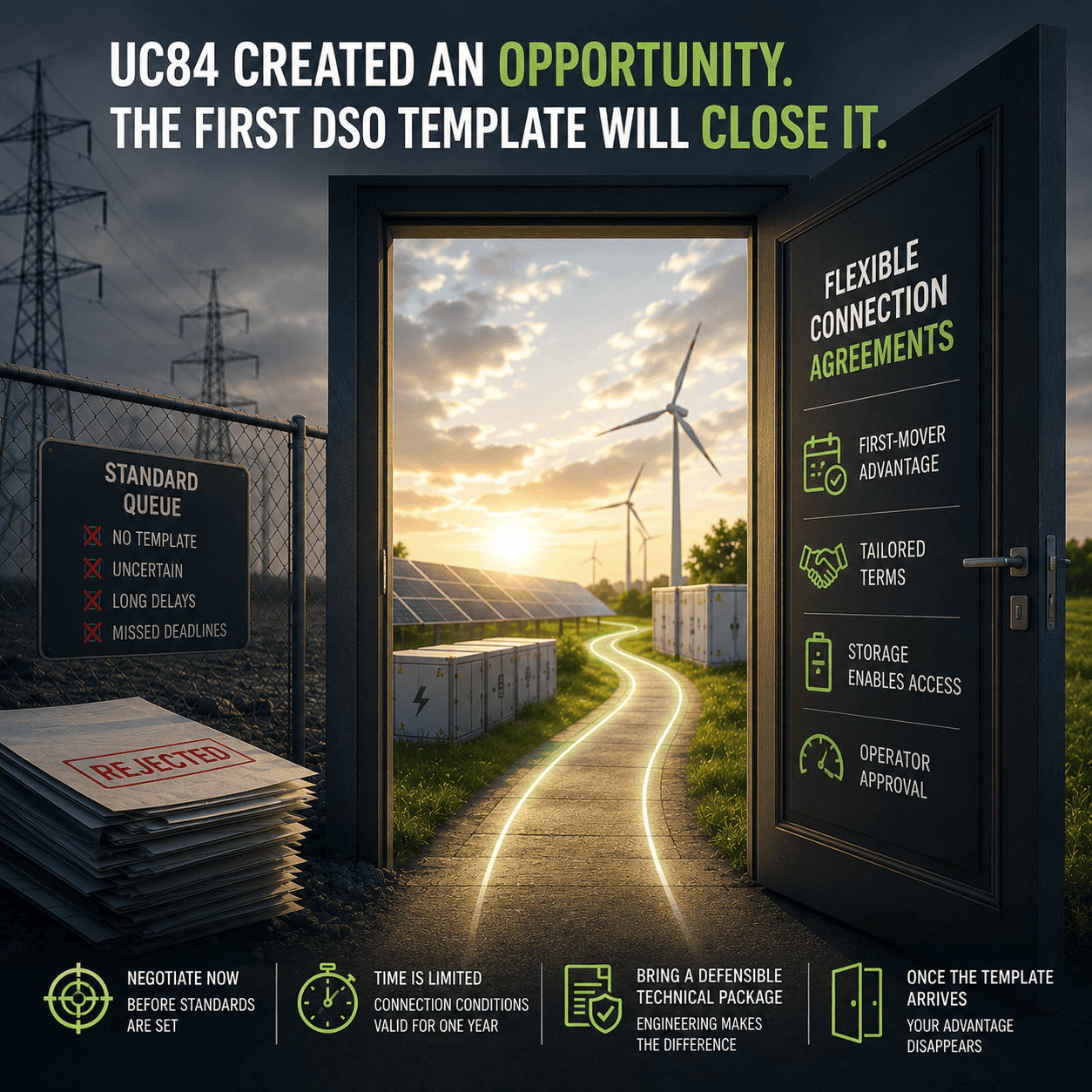
UC84 gave you the right to propose a flexible connection agreement. No Polish operator has a working template for it yet. That gap is your first-mover window, and it closes without warning.
Right now an operator engineer somewhere in Poland is looking at your rejected connection application next to two or three that look almost the same. He has no template to score them against, so he decides on judgement, with no published criteria. That ends the day a standard template appears, and nobody will announce the date. When it happens, your custom proposal turns into one more checkbox in someone else’s process, filed behind everyone who already had a compliant package on the desk when the door opened.
This article is for Renewable Energy Sources (RES) investors and developers in Poland with a stalled or rejected connection application, deciding whether it is worth fighting for or better to wait out the standard queue.
Your lawyers told you UC84 gives you the right to propose a flexible connection agreement, something close to the Dutch ATR85 model or cable pooling. That part is true. What they will not tell you is that not one of the major Polish DSOs, PGE, Tauron, Enea, Energa or Stoen, has a published template for that kind of agreement today. There is no published curtailment algorithm, no accepted BESS sizing methodology for compliance, and no approval checklist an engineer can point to.
The Dutch benchmark: flexibility made contractual
The Netherlands has not solved its grid crisis, and it is not pretending to. What it did was buy capacity and time with contractual engineering, while it keeps building the grid underneath. Those flexible contracts are the part Poland can copy first, because they work on the grid that already exists. Several contract types now do the heavy lifting there:
- ATR85 (Alternative Transport Rights). Full firm capacity for at least 85 percent of the year, with curtailment on the remaining 15 percent during peak congestion, in exchange for a lower tariff.
- NFA (Non-Firm Agreement). No guaranteed capacity during congestion windows. You export only when the grid allows, which only works with local storage behind the connection.
- TDTR (Time-Dependent Transport Rights). Capacity tied to fixed time blocks. Night export for wind, day export for solar.
- CSC (Capacity Steering Contract). Active control, where a battery or other flexible asset feeds in or backs off on the operator’s request to relieve congestion, in return for a fee. This is the contract that turns a battery from a revenue asset into a grid tool.
Cable pooling sits next to these as a separate mechanism, several assets sharing one connection point, and it is the closest Dutch parallel to what UC84 now allows in Poland. In each of these arrangements the battery earns its place as the physical control that lets the operator say yes. The revenue case follows once that control is in place. Every one of these agreement types started life as a custom-negotiated exception before it hardened into a standard form. Poland is at the exception stage right now.
The Polish reality: a legal right without a working process
UC84 introduced the legal basis for flexible connection agreements and cable pooling. The Polish DSOs and the TSO do not yet have standardized technical templates for them. UC84 gave you the right to ask for a flexible agreement. Getting a yes is a separate problem, and it is the one that stalls projects. Until a standard exists, the engineer across the table decides case by case, and he decides in favour of whoever brings the most defensible technical package first.
Why this window closes fast?
Once a DSO publishes a standard ATR85 or NFA template, three things happen at once. The technical bar becomes public, so every competitor can meet it. The queue absorbs the easiest projects first, the ones already holding a compliant package when the door opens. And the premium on being early, on negotiating terms before they harden into a checklist, is gone.
There is a second clock running underneath this one. UC84 cut the validity of connection conditions from two years to one, so the time to bring a defensible technical package is not hypothetical. It is already counting down on your own document.
This deadline never appears on a calendar. It arrives without notice, favours whoever’s package is already on the desk, and closes for everyone else on the same day. The legal question is settled, UC84 answered it. The open question is whether you can deliver, today, the technical package a conservative operator engineer can sign off on, before that requirement gets standardized and your head start disappears with it.
The playbook
You cannot run a standard connection application for a non-standard agreement. It has to be negotiated with a technical package an operator engineer can defend to his own management, rather than filed as paperwork and left to wait its turn.
Bring your own load flow analysis. Do not wait for the operator to define your limits. Prove mathematically that your solar, wind and storage hybrid will not breach local thermal limits. A technically incomplete proposal rarely gets a clean rejection. It gets shelved, and it sits there indefinitely.
Reposition the storage. Stop modelling the battery purely as a capacity-market or balancing-market revenue asset. Model it as a CAPEX line for connection compliance, the mechanism that makes your non-firm or steering proposal credible to a risk-averse operator.
Draft the operational annexes yourself. Since the operator has no standard flexible agreement to hand you, you supply the operational logic: the curtailment hierarchy, the SCADA telemetry handshake, and how the plant behaves when a congestion event hits and the signal drops.
We start with the load flow. Then the BESS sizing, because it only means something once the flow is on paper. The operational annexes come last, and a DSO engineer will not read them seriously without the first two already in front of him.
Which projects are worth the fight?
Not every stranded project belongs in this playbook. Before you commit engineering hours to a custom agreement, answer three questions.
Is the rejection technical or positional? A project rejected for a genuine thermal or voltage violation needs a different fix than one simply queued behind saturated capacity.
Does the asset mix support a credible storage-based mitigation story? A standalone PV or wind asset with no storage is a much harder sell than a hybrid that can demonstrate active curtailment control.
Is there enough runway before standardization? A project early in permitting has more time to benefit from custom negotiation than one already facing a financing deadline this year.
A project that fails all three is not a lost cause. It is a different problem, and it belongs in the standard queue rather than in a custom engineering package that costs more than the delay it is trying to solve. We tell clients that before they spend on a proposal that was never going to justify itself.
Why GridLink?
A law firm will tell you UC84 gives you the right to a flexible agreement. It will not tell you whether the operator engineer at your specific node will accept it, because whether he signs is an engineering question and no lawyer can answer it. Big4 will hand you a high-level audit with recommendations, then leave the room before anyone negotiates a curtailment hierarchy line by line. Your EPC will build whatever gets approved, and its interest ends at construction, not at defending the terms you negotiated. A generic engineering boutique will run your load flow, and still not know what a Polish DSO engineer needs to see on paper to approve an agreement type he has never signed off on before.
We audit rejected or queued CEE pipeline, run the load flow simulations the DSO will not run for you, and structure the technical parameters of the flexible connection proposal, the curtailment hierarchy, the storage sizing and the telemetry logic, into a form a conservative Polish network operator can actually sign. Then we sit in the room and negotiate the operational terms directly with appropriate operator staff.
The law is already in force. The engineering package that makes it usable is not, and it will not exist for your project until someone builds it. UC84 also put your connection conditions on a one year clock, so the time to bring a defensible package is already running. The operators will standardize this eventually. Until they do, the yes goes to whoever puts the most defensible package on the desk first. After that, it goes to whoever the checklist favours, and the room to negotiate is gone.
Find out if your project is defensible, before the window closes
Have a stalled or rejected application sitting in a Polish operator’s queue? Send us the rejection notice or your queue status, and within 48 hours you get a straight read on whether a flexible connection agreement is technically defensible for your case, before you spend engineering hours finding out the hard way. Everything you share is covered by NDA.