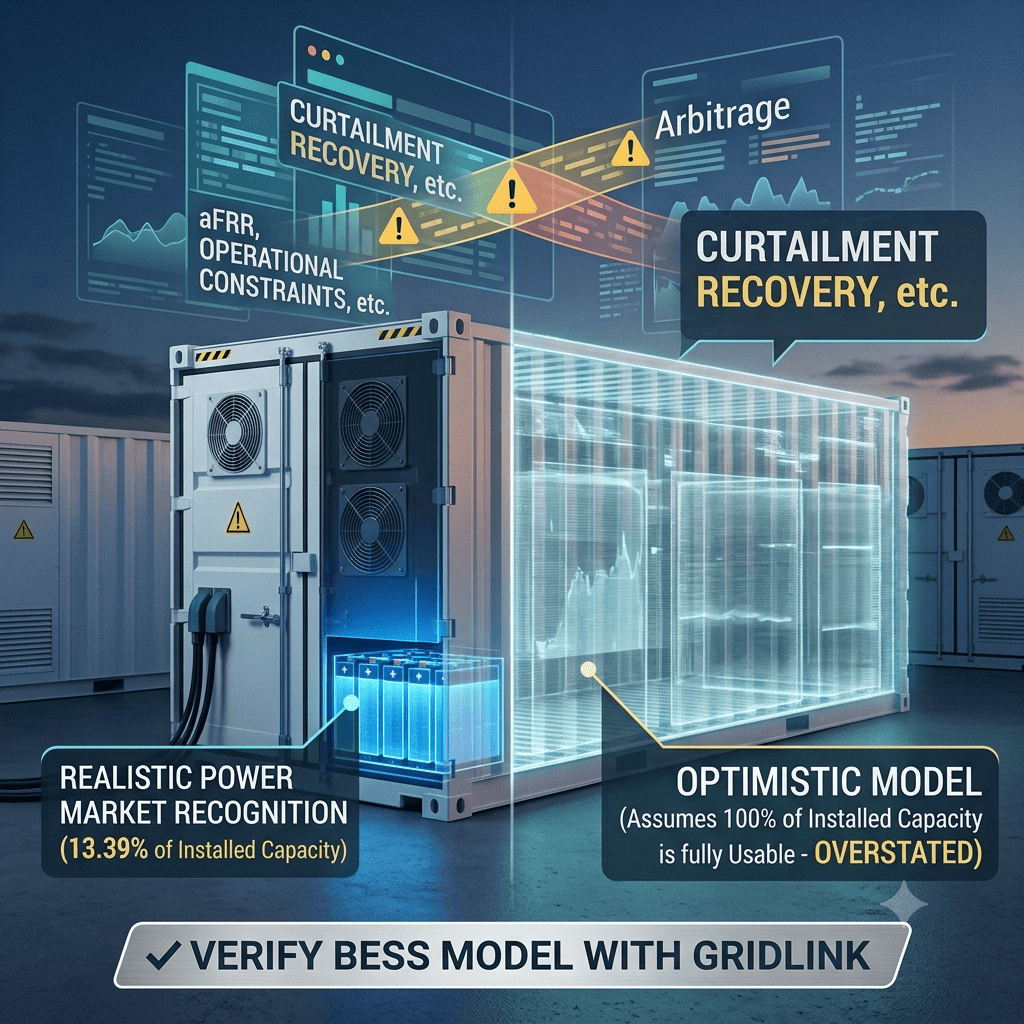
Poland’s December 2025 capacity auction cut the correction factor for Battery Energy Storage Systems (BESS) to 13.39 percent, down from 61.3 percent a year earlier and 95 percent the year before that. Of every 100 MW of nameplate capacity, the capacity contract now recognises about 13 MW.
Most BESS financial models built before that auction are still running on the old assumptions, and the gap is large enough to sink an Investment Committee memo on its own. The second gap is quieter. Capacity Market, aFRR, arbitrage, and curtailment recovery do not stack the way a spreadsheet lets you add them, because one battery has one State of Charge and one connection limit that every stream has to share.
Infrastructure funds are underwriting deals against a real signal from the Capacity Market while facing growing pressure to prove bankability through revenue stacking, layering price arbitrage, balancing services, and curtailment recovery on top of the capacity payment. Excel runs every one of those assumptions at full strength at the same time, without complaint. A real battery cannot. Committing State of Charge to one service leaves less of it for the next, and that shared physical envelope is where most BESS models fail under due diligence.
The capacity signal behind the model
The main auction for 2030 delivery closed at 465.02 PLN/kW/year on 11 December 2025. That price is the anchor most funds are underwriting against today. The same auction cut the correction factor for battery storage, the De-rating Factor (Korekcyjny współczynnik dyspozycyjności, KWD) in Polish market documents, to 13.39 percent. Across three consecutive auction cycles, the share of a battery’s nameplate capacity that counts toward a capacity obligation fell from 95 percent, to 61.3 percent, to 13.39 percent.
That collapse did not empty the auction of storage. The December round still granted close to 0.7 GW of new capacity obligations to battery projects, but at a fraction of the revenue per megawatt earlier auctions paid. Forum Energii puts total contracted storage across all auctions for delivery between 2027 and 2030 at roughly 5.1 GW. That figure is a four-year sum, and each additional gigawatt in it leans harder on aFRR, arbitrage, and curtailment recovery, because the capacity payment alone covers a smaller share of the economics every year. With that much storage chasing the same three revenue streams through 2030, the funds that model the overlap correctly are the ones that get financed first.
The myth of summing maxes
Many investors read the revenue stack additively. They take the maximum Capacity Market payment, add the optimal arbitrage volume from Day-Ahead and Intraday, and top it with an aFRR readiness premium, as though each stream ran on its own battery. A real battery shares every constraint across all four.
The result is a gap between the revenue an Investment Committee approved and the revenue the asset delivers in year one, and it widens with every stream stacked on top. Every service draws down the same State of Charge, so committing it to one tightens the availability the battery can offer elsewhere, and over time aggressive multi-service cycling degrades the cells faster than a single-purpose plan would. A stack that looks robust on paper but has never been pressure-tested hour by hour is exactly the artefact a debt or equity committee is trained to distrust.
Five modelling mistakes we see most in go or no-go models
1. Ignoring the availability conflict between the Capacity Market and aFRR. The Capacity Market demands full readiness to dispatch declared capacity during an operator call. If the battery is mid-activation on aFRR at that moment, its State of Charge may not let it meet the obligation. The penalty for non-performance is set annually by URE, and for 2025 it runs at 6,576.81 PLN per MWh of shortfall, on top of the capacity payment forfeited for that period. A static revenue strip misses this, and the miss usually surfaces late, when a lender’s technical advisor rebuilds the dispatch logic hour by hour and finds the double-counted revenue the model did not.
2. Overestimating arbitrage volume. Providing aFRR usually means holding the battery in a partial band, often somewhere around 40 to 60 percent State of Charge, with the exact band shifting by product and direction. That leaves physically less energy for deep arbitrage during the morning and evening peaks, so the spread gets realised on a fraction of nominal capacity. A model that assumes otherwise overstates arbitrage revenue from day one.
3. Underpricing degradation and the cycling regime. Optimising for the Capacity Market implies a shallow cycling regime with few full cycles a year. Squeezing aggressive arbitrage, say two cycles a day, out of the same battery accelerates LFP degradation well beyond that baseline. After three to four years, net capacity can fall enough to force early augmentation CAPEX, and that spend erodes the IRR the original model promised.
4. Treating curtailment recovery as a fixed number. Many developers assume a co-located battery absorbs almost all curtailed energy from a PV or wind farm. Curtailment concentrates in hours of extreme oversupply, often the same hours when prices go negative. A two- or four-hour battery fills in the first phase of the reduction, and the rest is lost unless exporting it in that same window is profitable and physically possible. Without generation-profile analytics for the specific node, the assumed recovery volume has no basis.
5. Skipping grid connection optimisation through cable pooling. Treating the BESS and the Renewable Energy Sources (RES) installation as independent entities on one connection wastes headroom from the start. Sharing infrastructure through cable pooling requires power-flow control built around the exact limits written into the issued Grid Connection Conditions for that point.
One caveat belongs here, because a sophisticated buyer will raise it. Cable pooling is not a universal fix. If the issued Grid Connection Conditions leave no real headroom for co-optimised dispatch, no optimiser manufactures value the connection cannot physically support, and that project needs a different lever, such as a capacity upgrade application or a different technology mix. We tell clients which situation they are in before they spend on the work.
Why GridLink?
We price BESS assets as a non-linear optimisation problem, built from hourly grid-constraint data and validated cycling profiles rather than from static revenue strips. The grid logic comes from the same engineering team that has taken more than 800 MVA of generation and storage capacity through the Polish connection process, led by dr inż. Michał Gajdzica, co-founder of GridLink and an academic specialist in power systems and protection. On that base we built the Cable Pooling Optimizer, a tool for developers, funds, and investors that catches the five mistakes above before they reach an Investment Committee.
The Optimizer maximises the use of your declared connection capacity without breaching its physical and regulatory limits. It models the trade-offs between the Capacity Market, balancing services, and arbitrage in hourly and sub-hourly resolution, so the conflicts between services show up as constraints inside the model months before financial close. It also prices the real value of storing curtailed energy against what the battery would have earned by providing a service such as aFRR in that same hour. A bankable case starts with correctly issued Grid Connection Conditions that already account for cable pooling, because a revenue model added afterward has to work around limits fixed months earlier. We guide companies through the full formal and legal connection process and build the operational tools that let a BESS model survive contact with a committee.
Three questions worth running before the next Investment Committee
Does the model let the Capacity Market and aFRR draw on the same State of Charge in the same hour, or does it treat them as separate batteries?
Is the KWD correction factor it uses the figure for your actual delivery year, or a carryover from an earlier auction?
When it prices curtailment recovery, does it compare that revenue against what the battery would have earned on a balancing service in that same hour, or count the curtailed energy as free upside with no opportunity cost?
December’s auction was the last main auction under the capacity market rules in force since 2018. Whatever mechanism replaces it for delivery after 2030 is still being designed, so every assumption resting on the next auction looking like the last one needs a second look, wherever your project sits in the queue.
Pressure-test the stack before the committee does
A bankable BESS revenue stack comes from modelling the Capacity Market, balancing services, arbitrage, and curtailment recovery together, hour by hour, against the physical and regulatory limits of your connection. Send us your current revenue-stack assumptions and we will flag where they conflict with your actual Grid Connection Conditions.
For a full validation before the next supplementary auction, book a Cable Pooling Optimizer review. We sign an NDA before we look at a single number, and you get back a validated hourly revenue stack your Investment Committee can rely on.