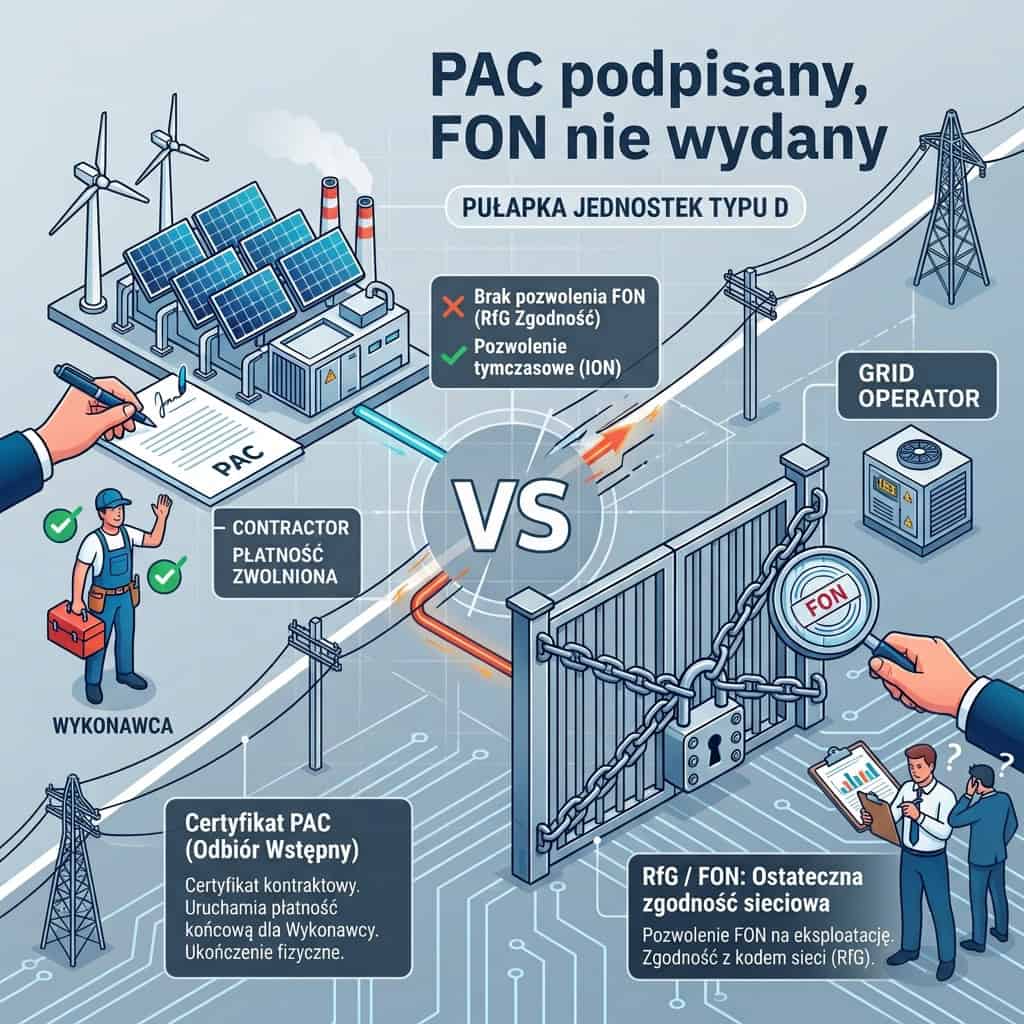
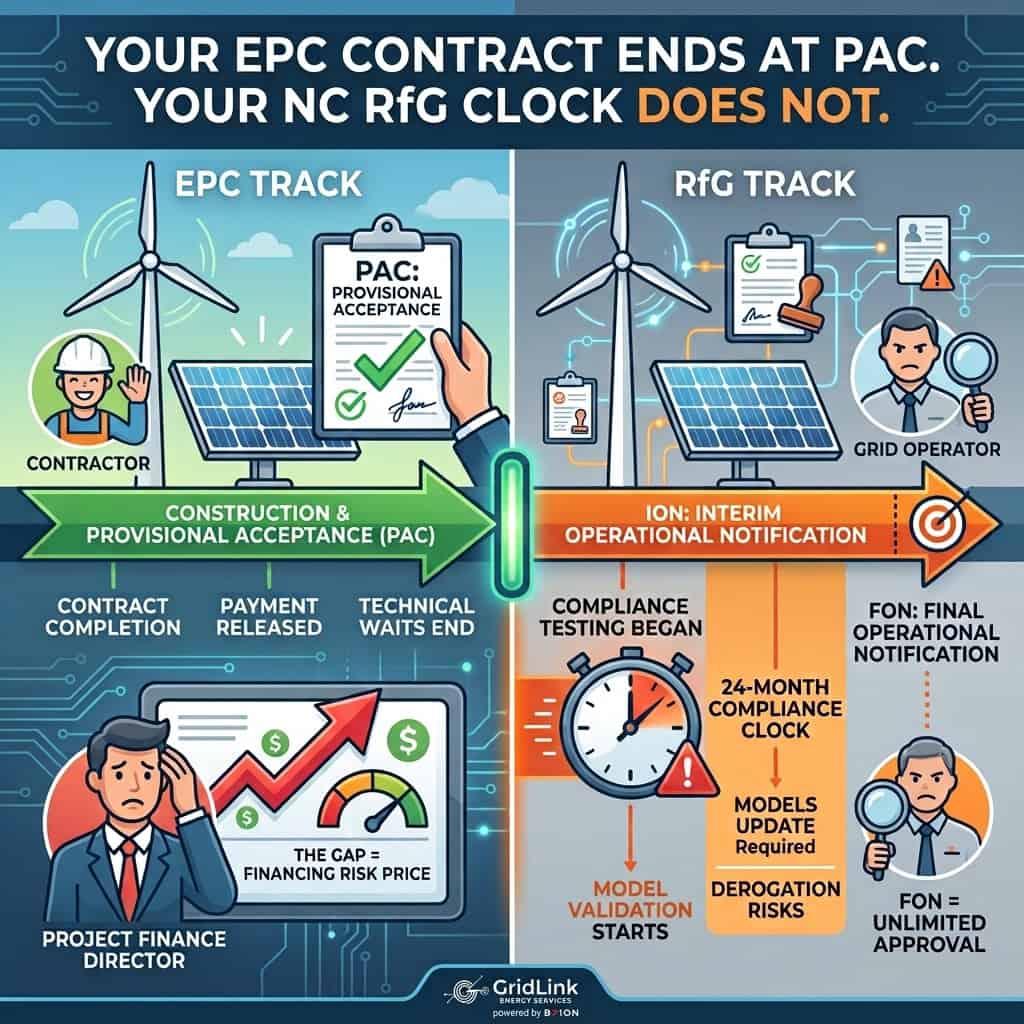
Your EPC contract has a completion date. The grid operator has a different one. Lenders price that gap as risk long before anyone on the project team notices it. If you are the project finance director, or the person on the investor side who plays that role, both dates are your problem, whether or not the EPC contract admits it.
Two schedules, and your contract tracks only one
A Provisional Acceptance Certificate (PAC) tells your lenders the plant works. It tells nobody at PSE, Tauron Dystrybucja, PGE Dystrybucja, Enea Operator, Energa-Operator or Stoen Operator anything at all. PAC belongs to the construction contract, and the commissioning test behind it comes from the contract too.
That test is worth a second look, because contracts routinely cite the wrong standard for it. For photovoltaic installations (PV), IEC 62446-1 covers documentation, commissioning tests and inspection. It does not set out how performance ratio is measured. That method belongs to the IEC 61724 series. For wind there is no plant-level equivalent at all: IEC 61400-12-1 measures the power curve of a single turbine and IEC 61400-12-3 covers site calibration for that measurement, so whatever your wind PAC measures was defined by your lawyers. Lender-side reviewers read these citations closely, and a PV metric applied to a wind farm costs a technical advisor’s confidence in the whole pack.
Grid-code compliance under NC RfG and the applicable IRiESP or IRiESD runs on its own track, with its own paperwork and its own deadlines. One correction on sequencing, because project schedules often reverse it: you cannot energise first and notify later. The Energisation Operational Notification has to be in hand before the internal network goes live. The clock that decides your financing case starts later, when the Interim Operational Notification is issued.
Most EPC contracts never mention this second schedule. That gap is what follows.
Which projects this applies to
The EON, then ION, then FON sequence sits in articles 33 to 36 of Commission Regulation (EU) 2016/631 and governs Type D modules. Article 5(2)(d) puts a unit in Type D if its connection point is at 110 kV or above, whatever its capacity, or if it sits below 110 kV with a maximum capacity at or above the national threshold, which for the Continental Europe synchronous area cannot exceed 75 MW. Below that line the route runs through a power-generating module document, defined in article 2(10) and issued under article 32, for Types B and C, or an installation document under article 30 for Type A. Worth keeping separate while you read your own file: a PGMD is not a certificate of conformity (poświadczenie zgodności). The latter, the statement of compliance in article 2(61), is one component of the evidence, and on the Type D route it appears at ION and again at FON.
Check which type your connection conditions assign to your PGM (Power Generating Module) before assuming either way. The answer drives the entire compliance budget.
What each notification buys you
Energisation Operational Notification, article 34
EON (Energisation Operational Notification) is the first step and the most commonly misread. The regulation makes its issuance conditional on completing preparations, and it names one of them: agreement between the operator and the facility owner on the protection, signal exchange and control settings relevant to the connection point. What EON then authorises is narrow. You may energise the internal network and auxiliaries. You may not generate into the grid.
Article 7(5) is the provision nobody quotes. Where the regulation requires the parties to reach an agreement, they must use their best efforts within six months of the first proposal, and failing that either party may ask the regulatory authority to decide within six months more. The clock runs from your first settings proposal, not from your first chaser. Know the date and be able to evidence it.
Interim Operational Notification, article 35
ION (Interim Operational Notification) authorises operation of the module using the grid connection for a limited period, and it allows compliance testing to begin. Before issuing it the operator has the right to request a detailed statement of compliance, technical data, equipment certificates from an authorised certifier where those form part of the evidence, simulation models under article 15(6)(c), steady-state and dynamic performance studies, and details of the planned compliance tests. That is a right to request rather than a fixed checklist, and what each operator asks for at ION instead of FON (Final Operational Notification) differs enough to matter.
ION status is capped at 24 months, and the operator may set a shorter validity period. Two separate mechanisms then sit behind that cap, and project schedules routinely merge them. An extension inside the 24 months is granted only where the owner has made substantial progress toward full compliance, with the unresolved issues clearly identified at the point of application. Going beyond the 24 months is a different instrument: a derogation request under the article 60 procedure, which must be submitted to the operator before the period expires.
Final Operational Notification, article 36
FON has no expiry. The operator issues it once every incompatibility identified for ION status has been removed and the data and study review is complete. For that review the owner has to submit an updated statement of compliance and updated technical data, simulation models and studies, incorporating values actually measured during the tests. A model that never met commissioning data does not satisfy that.
Article 36(4) covers the case lenders should be asking about. If an incompatibility is identified at the FON stage, a derogation can be requested under Title V, and FON is then issued if the module meets the derogation’s terms. If that request is refused, the operator may withhold permission to operate until the incompatibility is cleared. Where the parties fail to clear it within a reasonable period, and in any case within six months of notification of the refusal, either of them may refer the matter to the regulatory authority.
After FON, the instrument almost nobody budgets for, article 37
If a FON-holding unit is temporarily subject to significant modification or loss of capability, or suffers equipment failure leading to non-compliance, the owner has to inform the operator without delay. Where the situation can reasonably be expected to last longer than three months, the owner applies for a Limited Operational Notification. A LON runs for no more than 12 months, and FON is suspended for the items it covers.
Then comes the sentence that belongs in every credit paper and appears in almost none. Once the LON is no longer valid, the operator has the right to refuse to allow the module to operate, and the FON automatically becomes invalid. An asset that held an unlimited authorisation is back at the start of the ladder, years after commercial operation was confirmed.
The derogation route runs longer than the runway it is meant to protect
Here is where most project schedules break, and it is a timing problem rather than a drafting one. Filing a derogation before ION expiry preserves your position, because article 35(5) requires submission before the period ends, not a decision before it ends. Getting an answer is a separate matter, and article 62 sets out how long that takes.
Statutory timetable for a derogation request, article 62
Two weeks for the operator to confirm whether your request is complete.
One month for you to supply anything missing. Miss it and the request is deemed withdrawn.
Up to six months for the operator to forward the request to the regulatory authority, extendable by one month where it seeks further information, or by two where it asks the TSO for an assessment.
Up to six months for the regulatory authority to decide, counted from the day after receipt, extendable by a further three months.
Two months for you to answer any information request from the regulator, again on pain of deemed withdrawal.
Stack the ceilings and a derogation can legitimately take the better part of fifteen months. Against a 24-month ION cap, a filing prepared in month twenty-two is not a contingency. It is a position you hold while the process runs.
What the public record shows
You can check this yourself. The Polish regulator keeps a public register of derogations from network code connection requirements under article 64 of the same regulation. As at March 2025 every NC RfG entry in it, eight of them, concerned one thing: extending ION status under article 35(5). Five of those decisions carry 2024 dates, two on projects connected to PSE’s transmission network and three on Energa-Operator’s distribution network. The applicants are generators, wind projects in each case.
Read that register the way a credit committee would. Running out of ION runway is a recurring event in this market, it happens to named projects, and the remedy leaves a public trail. Each operator also runs its own forms and internal timelines for the same statutory ladder, so which one you are dealing with shapes how closely your project tracks the law on paper.
Where this becomes a financing problem
Lenders tie drawdown, debt service commencement and liquidated damages to a Commercial Operation Date defined in the EPC contract, and that definition usually mirrors PAC or a close variant. Under NC RfG the asset is not unconditionally authorised until FON. Between the two, a project can generate and deliver energy while sitting on the operator’s 24-month clock, carrying a compliance status the EPC contract never priced.
Take a 120 MW onshore wind project, Type D, connected at 110 kV. The numbers below are illustrative, so substitute your own. ION is issued in month three, which caps it at month twenty-seven. The contractor issues PAC in month twenty-five, the milestone payment is released and the liability period starts. Two months of ION runway remain, and the commissioning data still does not support the updated statement of compliance that FON requires. No derogation has been filed.
Now price it. At a 30 percent capacity factor that farm produces roughly 26 GWh in a month. Multiply by your own PPA or merchant curve, add the debt service falling due over the same period, then compare the result with the liquidated-damages cap in the EPC contract. That cap was sized against construction delay, not against a compliance status nobody drafted for. What moves the number most: whether your offtake agreement fixes a delivery start date, whether the operator restricted output during ION, and how much of the compliance evidence sits with a contractor who has already been paid.
When a review helps, and when it is too late
Some of this cannot be fixed by reading the contract again, and we would rather say so. If ION expires in a few weeks and compliance testing has not started, no adviser reverses that. What is left is a derogation filed before the deadline, an honest reconstruction of whatever evidence still exists, and a conversation with your lender held on numbers instead of assurances.
The review earns its fee earlier: while the EPC contract is still being negotiated, while the final milestone payment is unpaid, during detailed design when the settings agreement can still be opened, or while more than six months of ION runway remain. Outside those windows we say so rather than sell a review that changes nothing.
What belongs in the contract and the tracking sheet
Checks that catch most of this before it becomes a financing conversation
Confirm your module type against article 5(2)(d) before assuming the ladder applies to your connection at all.
Pull your ION issuance date, calculate the 24-month cap or the shorter one your operator set, and calendar it independently of the EPC schedule.
Record the date of your first protection and control settings proposal, because the article 7(5) period runs from it.
Check whether your EPC contract’s Commercial Operation Date or Final Acceptance definition references FON. In the contracts we review it usually does not.
Work backwards from the article 62 timetable, not forwards from today, when you decide the latest sensible date to start preparing a derogation filing.
Ask your operator in writing which of its EON, ION and FON forms and internal timelines apply to your connection specifically.
Confirm who owns the raw commissioning data, in what format, and whether that survives the contractor’s demobilisation.
Where GridLink fits
This is the review we run as Owner’s Engineer on the investor side. We map your EPC milestones against the operator’s NC RfG and the applicable IRiESP or IRiESD requirements, track the ION clock independently of construction progress, and prepare the statement of compliance and derogation documentation in the form the operator will accept, working from your connection conditions and commissioning data. We carry out calculations, analyses, reviews and reports, and we set out risks and recommendations. We do not design, we do not build, and we do not take over responsibility for anyone else’s documentation. What we tell you is where your two schedules stand, while there is still time for the answer to be useful.
Where does your ION clock stand
Issued more than eighteen months ago. Work out today whether a derogation filing can realistically be prepared, and assume the operator will need its full article 62 period.
Issued six to eighteen months ago. This is the window where a contract review still changes the outcome, because the contractor is usually not yet fully paid.
Issued within the last six months. You have runway. Spend it on the settings agreement and on locking down who hands over commissioning data.
Not yet issued. Everything above is still a drafting question rather than a recovery exercise, and that is the cheapest place this problem is ever solved.
Two ways to test this against your own project
Not sure whether the Type D threshold applies to you? Send your connection voltage and installed capacity. Two lines is enough, and no project documents are needed to answer that one.
If the clock is closer than you would like, send your connection conditions and EPC schedule this week, before another month comes off your own ION cap. We will map both timelines against each other and flag the derogation filing before the deadline forces a rushed one.
Michał Gajdzica, PhD, is a co-founder of GridLink Energy Services. The team has more than 800 MVA of capacity connected to operator networks in Poland, on projects run from connection conditions through to FON.