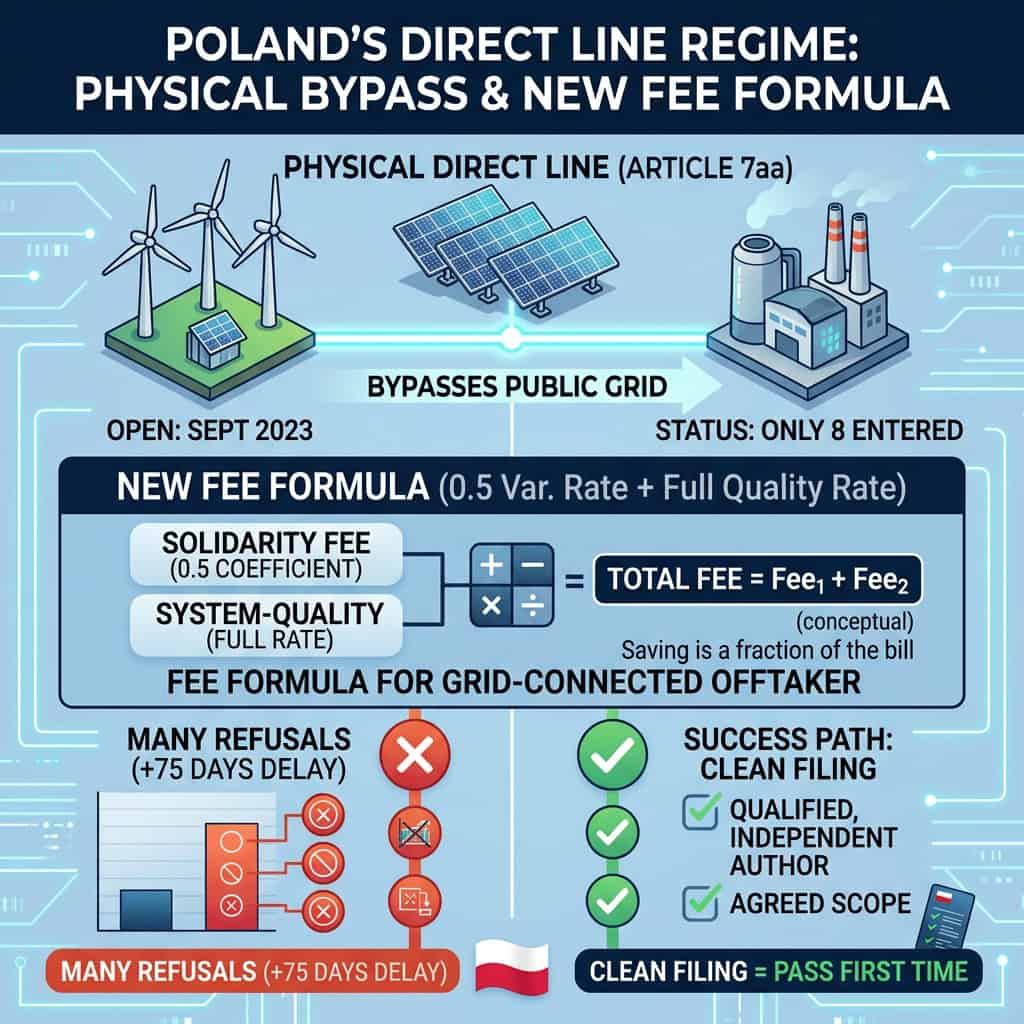
Poland’s direct line regime has been open since 7 September 2023. The Poland’s Direct Line Regime: Eight Filings in Three Years, and a Fee Formula in Force Since 5 September 2026 has entered eight lines onto the public register in that time, and the version published today shows seven of them. Until this month the biggest unknown in any feasibility case was the fee a connected offtaker would owe on direct-line volume. That number now has a formula behind it. A regulation of the Minister of Energy dated 3 September 2026, published as Journal of Laws 2026, item 1182 (Dz.U. 2026 poz. 1182) , took effect on 5 September . It fixes the solidarity-fee coefficient at 0.5 of the variable network rate and charges the system-quality rate in full.
Corporate Power Purchase Agreement (PPAs), meanwhile, are having a good run here. EDP signed a 322 MW hybrid wind-and-solar contract with Energa Obrót, which is a licensed trading company. The buyer side of that deal sits in the utility sector, and that says something about where the volume goes. Almost none of it touches a direct line. The gap between a busy PPA market and a single-digit register is where a feasibility study earns its fee.
Two mechanisms with one confusing name
„Corporate PPA” and „direct line” get used almost interchangeably in casual conversation about Poland’s renewables market, and the habit causes real planning mistakes. A corporate PPA is a commercial contract. A buyer agrees to take renewable output from a generator over a long term at an agreed price, for reasons ranging from cost certainty to an ESG target. Most Polish corporate PPAs are sleeved through the public grid under a standard supply arrangement, or structured as a virtual contract with no physical delivery link at all.
A direct line, under Article 7aa of the Energy Law (Prawo energetyczne), is narrower and more specific: a physical connection between a generating unit and a consumer that bypasses the distribution or transmission network for that particular flow of energy. A project can run a corporate PPA without ever building a direct line, and in Poland that is what almost everyone does.
The distinction in one box
Corporate PPA. A commercial contract, usually settled across the public grid, with no dedicated physical link.
Direct line (Article 7aa). A physical generator-to-offtaker connection that bypasses the distribution or transmission network.
A project can hold a corporate PPA with no direct line, and in Poland that is the norm.
The direct line is a delivery mechanism. Conflating it with a commercial structure at term-sheet stage is how a client ends up with a contract shaped for one regime and a connection point shaped for another.
What Article 7aa actually allows
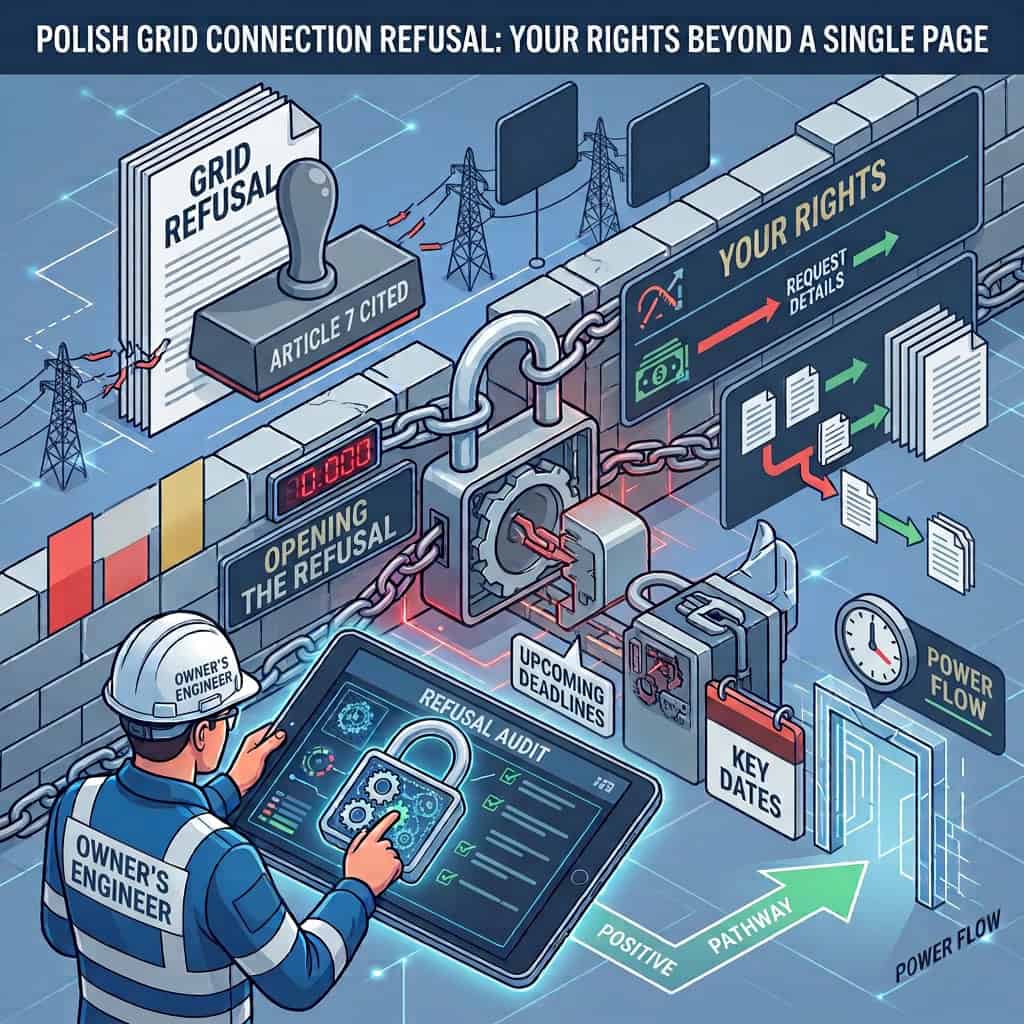
The 2023 amendment removed the old requirement for the President of URE administrative decision before building a direct line. A notification and register system took over. The party building or operating the line files a notification (zgłoszenie), and URE enters it onto the public list (wykaz) within 45 days of submission. The filing has to identify the generator and the offtaker, state the line’s voltage, length and location, and attach a single line diagram of power evacuation showing the connection together with the measurement points and the ownership boundaries. In most cases it also has to carry an analysis (ekspertyza) assessing the line’s impact on the wider power system.
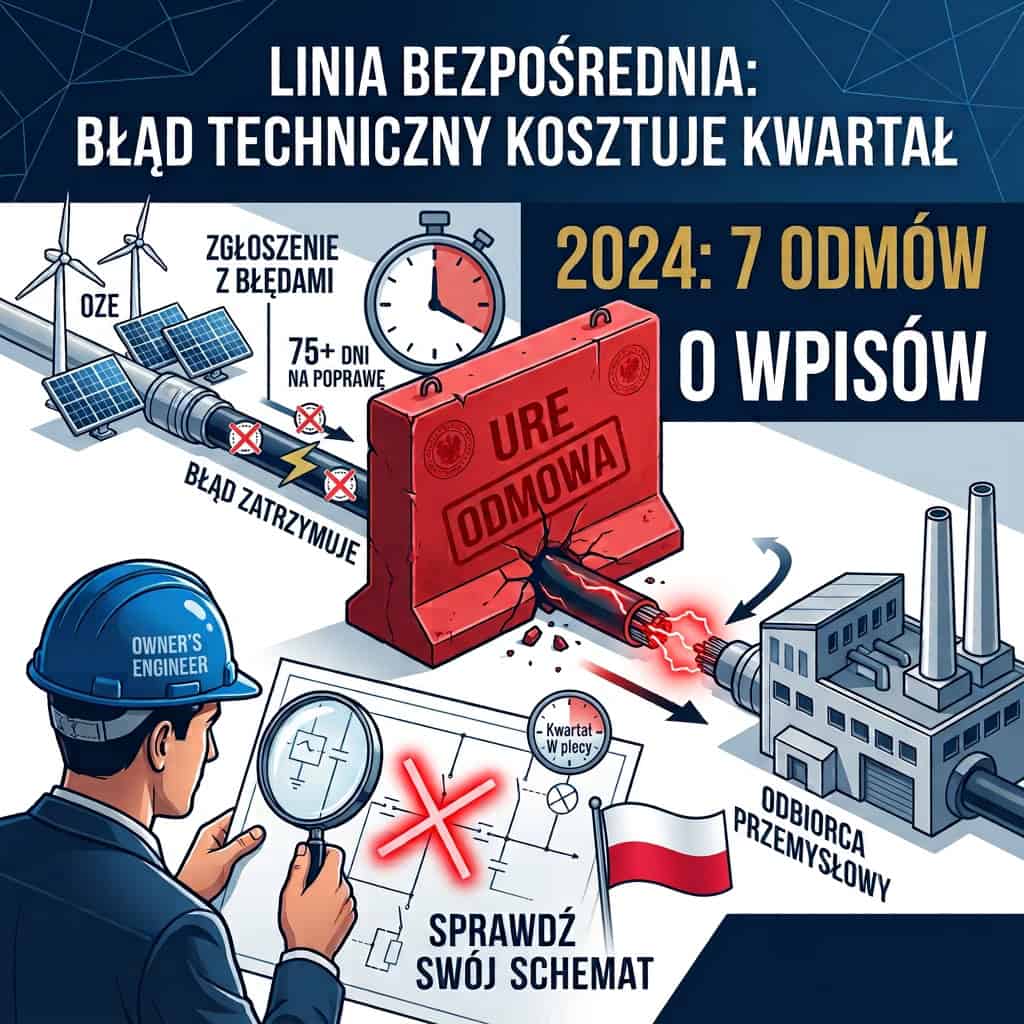
The 45-day clock is worth understanding in detail, because it decides what a drafting error costs. If URE finds gaps or errors in the information or the single line diagram , it does not refuse. It issues a summons (wezwanie) setting a deadline of no less than 30 days to cure, and once the correction lands the 45 days start again from that date. One badly drawn schematic therefore adds at least 75 days before any decision is reached. Refusal comes only where the applicant fails to cure within the deadline set. The rule runs the other way too: if URE takes no action inside the 45 days, the entry is made by operation of law on the first working day after the deadline expires. A clean filing is protected against delay. Everything turns on the quality of the documents.
The law allows two distinct routes into the simplified track. Each stands on its own. Under the first, the line delivers from a SGU (Separate Generating Unit) -wydzielona jednostka wytwórcza to a separate recipient (wydzielony odbiorca) who has no grid connection at all. No analysis (ekspertyza) is required and no capacity limit applies. Under the second, the line delivers to a separate recipient from a renewable installation, or to a licensed trading company for supply to its own facilities, its subordinate entities or consumers on its network. Here the conditions are cumulative: the equipment must be incapable of feeding energy back into the distribution or transmission network, or the statutory technical requirements must be met, and total installed generating capacity must not exceed 2 MW.
Most public discussion of Article 7aa assumes only the second route exists and treats the mechanism as a niche fit for rooftop solar. The first route is the one that matters for heavy industry, because it carries no megawatt ceiling. It also happens to be the only configuration that earns the full fee exemption, for the same reason in both provisions: the offtaker is not connected to the grid.
Seven names, and a lot of quiet years in between
URE published the notification form on 15 September 2023. The first entry followed on 19 December 2023: a 999 kWp rooftop PV installation feeding Mondelez’s plant in Skarbimierz over a 35-metre line at 15.75 kV, registered as LB/URE0001/2023. It stood alone on the register for more than a year.
2024 turned out to be the regime’s quietest year, well short of the breakout many expected. URE entered nothing at all and issued seven refusals. Every refusal traced back to the same family of drafting problems: a single line diagram of power evacuation that failed to mark the measurement point, an undefined boundary between the generator’s and the offtaker’s equipment, missing ownership demarcation, and in some cases a generating unit that did not meet the statutory definition of a SGU. Each of those is visible in a properly scoped technical review months before a rejection letter arrives.
The register published today shows seven live entries, running from LB/URE0001/2025 through LB/URE0002/2026. The numbering resets each calendar year, so the two 2026 entries do not continue the 2025 count. Pomorska Specjalna Strefa Ekonomiczna opened 2025 in January, pairing a PV farm with Kitron, a zone investor, in Kujawsko-Pomorskie. CTP Energy Poland appears twice, in April and August 2025. P.U.H. Matel and Energia Pomorze followed before the year closed, the latter holding the previous record for line length at 340 metres.
Two entries broke the pattern. Quanta Lease Fund VI, registered on 2 June 2026, connects a 3.6 MW PV installation to Stellantis’s Tychy plant over 2,460 metres, more than seven times Energia Pomorze’s record, and is the first entry to exceed the 2 MW threshold and go through the full ekspertyza and formal proceeding. DB Energy followed on 10 August 2026.
Mondelez’s original entry, the one that started the register, no longer appears on it. The document is still on URE’s BIP server and URE’s own press releases still count it, describing Pomorska SSE as the second line and Energia Pomorze as the sixth, but the published table now begins in January 2025. URE has given no reason. For anyone assessing this mechanism from headlines two years old, that absence is itself the lesson: read the register in the version dated the day you cite it.
Why size decides more than intent
The 2 MW line in Article 7aa ust. 23 pkt 2 decides which procedural track a project sits on for the life of the connection, and it applies to that route only. A project on that route stays simplified, with no analysis, as long as installed generating capacity stays under 2 MW and the offtaker’s equipment is genuinely incapable of feeding energy back into the grid. Cross the threshold, or leave any feed-back capability in place, and the filing needs a full impact study plus a complete URE proceeding. The document check alone no longer suffices.
Who signs that study is a statutory question, not a procurement preference. The author must hold a qualification certificate and at least ten years of experience in power system operation, and must be independent of the entity making the filing . The alternatives are a holder of a postdoctoral degree in engineering and technical sciences specialising in network operation, a research institute, a technical university, or a certified expert (rzeczoznawca). The scope, conditions and main assumptions of the study, including the underlying data, must be agreed in advance with the grid operator the offtaker will connect to, and that operator has 14 days to release the agreed data once asked. Article 7aa also makes refusal available where the study was prepared by a party failing those criteria, and separately where it was prepared negligently. An in-house engineer cannot sign it.
For a transmission-connected separate recipient there is a further layer, and its status is often misreported. PSE’s update card covering direct lines, separate recipient and SGU was approved by URE on 11 July 2025 and has been in force since 28 July 2025. It is a live obligation today, not a pending draft. The remaining, unapproved part of that update card went back to URE on 27 January 2026 after a consultation that closed on 28 November 2025. The core requirement is a dedicated regulation automation that stops energy from the connected generating unit reaching the transmission network. Volume that does reach it is charged on the same basis as illegal consumption. Either way it is a control-system requirement with real financial exposure, and it belongs in the feasibility conversation well before anyone signs a connection agreement for a generator above 2 MW.
Why the saving rarely reaches the number in the pitch deck
The most consequential misunderstanding in this regime concerns the fee exemption. Full relief under Article 7aa ust. 4 applies only to a separate recipient who is not connected to the public grid at all. Anyone who stays connected, even solely to draw backup power through equipment technically blocked from exporting direct-line energy, owes both the solidarity fee (opłata solidarnościowa) and the fee covering the cost of maintaining system quality and reliability standards, on the volume delivered by direct line. The capacity fee applies to metered grid consumption regardless of what share of total demand the direct line covers, so a facility drawing any residual power during the priced hours keeps paying it in full.
Until September the size of that bill was guesswork. It is not any more. Under § 33 of the new tariff regulation, the solidarity fee is calculated with a coefficient kLB, a correction factor used to calculate the solidarity fee, set at 0.5 , applied to the variable network rate for the relevant tariff group and time zone, multiplied by the energy delivered over the direct line. The system-quality element rides on the same volume at the full quality rate, with no reducing coefficient. In plain terms, a grid-connected offtaker pays half the variable network rate and all of the quality rate on every megawatt-hour that never touched the public network, and continues to pay the capacity fee on whatever it still draws from the grid.
That is the arithmetic most term sheets get wrong, because they start from the full exemption. Whichever way that example lands, the point holds. The saving is a fraction of the bill, and that fraction is now calculable.
For a growing number of projects the more attractive answer has been to skip the direct line and build generation as a straightforward autoproducer installation behind the meter, with no separate trading structure and no Article 7aa filing. That shift is useful diagnostic information in itself. When the regulated version of an idea keeps losing to the unregulated version of the same idea, the regulation is worth re-examining before the next project gets designed around it.
What actually changes in 2026
Two developments this year change the calculation, and they pull in opposite directions.
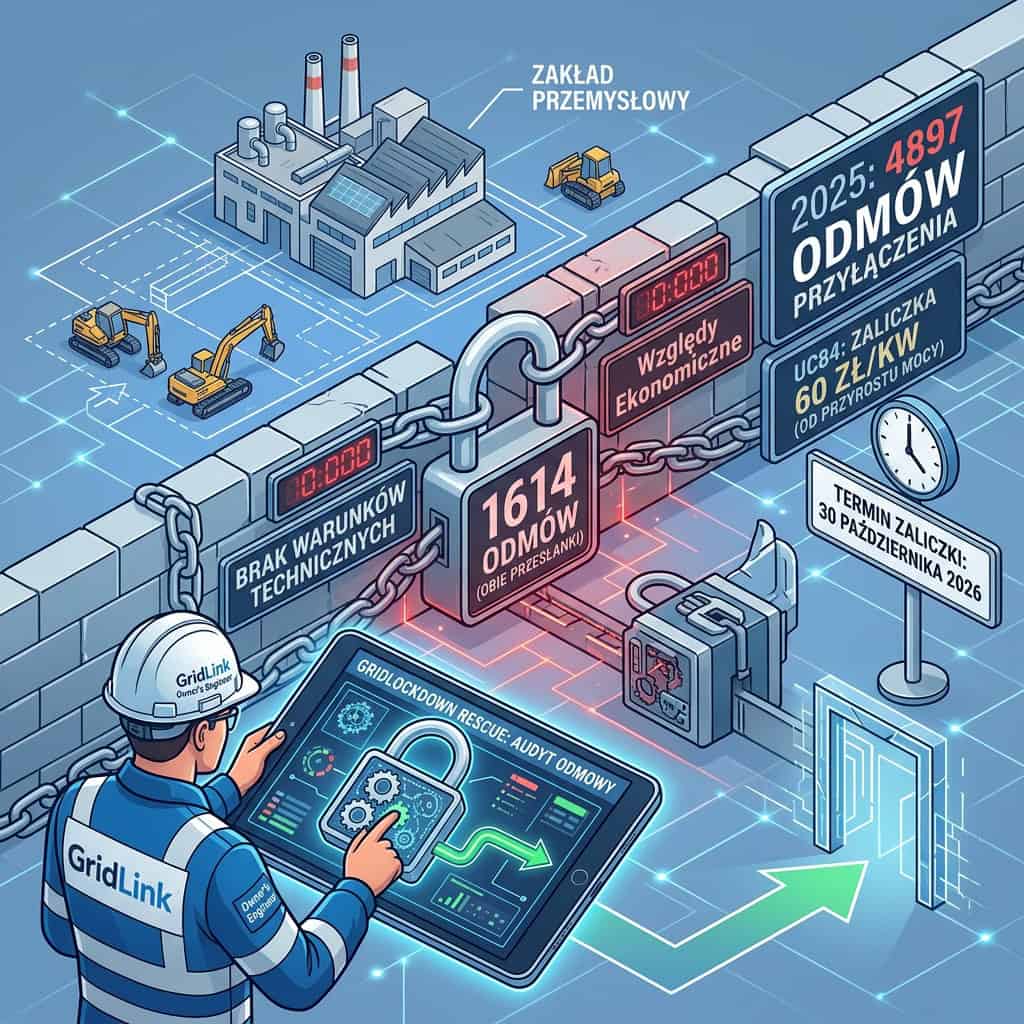
The first is UC84, the connection-process reform in force since 30 April 2026. Article 7aa sits outside its scope. What UC84 raises is the cost and risk of the ordinary grid connection that serves as the default alternative to a direct line. The advance against the connection fee doubled from 30 to 60 zł per kilowatt, capped at PLN 6 million. It is credited against the final connection fee, and forfeited where the agreed conditions are not met. Financial security runs at 30 zł per kilowatt up to 100 MW and 60 zł above that, capped at PLN 12 million and payable within 14 days of signing. Construction milestone deadlines now carry real risk of a connection agreement lapsing before commissioning.
Those terms are firmer than the market expected, because the amendment meant to soften them did not survive. On 28 August 2026 the President refused to sign the act of 31 July 2026 amending UC84’s transitional provisions. That amendment would have moved the advance deadline from 30 October 2026 out to April 2027 and resolved the ambiguity between the 100 percent security level applying to 15 October 2026 and the 25 percent level applying from 16 October. With the veto, the original dates stand. Any project weighing a direct line against an ordinary connection is now doing so against a live October deadline on the alternative.
The second development is specific to Article 7aa. A regulation of the Minister of Energy on tariff calculation and settlement in electricity trading was issued on 3 September 2026 under Article 46 ust. 3 of the Energy Law. It was published on 4 September as Journal of Laws 2026, item 1182 (Dz.U. 2026 poz. 1182) and took effect on 5 September. Section 1 points 15 and 16 name both direct-line fees by reference to Article 7aa ust. 4, and § 29 and § 33 carry the mechanics. This sits inside the general tariff regulation, which is why most market commentary missed it. One transitional rule is worth knowing. In tariffs applied from 2027 to 2031, energy-intensive end users meeting defined consumption and cost thresholds get a coefficient of 0.1 on the quality fee, which changes the quality-side arithmetic for exactly the industrial profile a direct line is meant to serve.
Taken together, 2026 repriced both sides of the comparison at once. The grid-connection alternative got more expensive and now carries a hard October date. The direct line’s cost structure moved from an open legal question to a published formula. Guessing wrong on either the fee math or the 2 MW threshold costs a filing cycle at minimum, and at the sizes now appearing on the register it costs real money.
How Spain and the Netherlands built the same idea into something used at scale
The direct line transposes an obligation in Directive 2019/944 that every EU member state shares. Spain and the Netherlands show what a broader, more embedded version of the same idea looks like next to Poland’s single narrow gate.
Spain folded its línea directa into a mature autoconsumo framework under Real Decreto 244/2019. A project there does not have to fit the literal definition of a private wire. The same regulation treats generation inside the consumer’s own installation, or sited within 500 metres of it, or sharing a low-voltage transformer, as equivalent routes into the regime. Industry association UNEF put installed autoconsumo capacity at 9.3 GW at the end of 2025, with 1,139 MW added during the year. The industrial segment took 679 MW of that and grew slightly, in a year the sector itself calls a slowdown. The PNIEC target is 19 GW by 2030, which on UNEF’s arithmetic needs roughly 2 GW a year.
The Netherlands reached a similar outcome by a different route. Facing serious grid congestion, the government’s own enterprise agency RVO promotes the direct line as one of a named set of tools for a business trying to avoid a congested connection. The regulator ACM runs a public register built on a simple notification duty, lighter even than URE’s process. A bare notification leaves the statutory question open, and legal certainty comes only from a separate ontheffing application. The institutional posture is the real difference. The Dutch state markets the direct line as an answer to a congestion problem businesses already feel, while Polish businesses rarely reach for the mechanism on their own.
What to check before anyone commits to a route
Five questions to answer before the term sheet
Will the offtaker stay disconnected from the public grid, or keep a connection for backup? A retained connection puts the full exemption out of reach and sends the project into the § 33 formula.
Does installed generating capacity sit under 2 MW with genuine, verifiable feed-back incapability, or does the project need to plan from day one for a full analysis and a formal URE proceeding?
Does the single line topology of power evacuation mark the measurement points and the ownership boundaries to a standard that survives URE’s review on the first pass?
Who will sign the analysis, and are they independent of the filing entity as the statute requires? Has the scope been agreed with the grid operator yet?
Does the arrangement need to be a direct line at all, or would an autoproducer build behind the meter reach the same commercial outcome?
A team that answers the last question with autoproducer has reached the same conclusion as the growing number of projects described above, faster and before signing anything.
Where GridLink fits
If you sit on a site-selection or legal team and have to sign off on a generator-to-offtaker pairing, this is engineering-led due diligence, grounded in how URE and PSE apply the statute in practice. Whether a single line diagram of power evacuation survives URE’s scrutiny, whether the capacity figure sits under the 2 MW threshold on the route the project is actually using, and how the September fee formula reads against a real connection point are all questions with commercial consequences. Getting any one of them wrong costs a filing cycle at minimum.
GridLink works on the owner’s and investor’s side of exactly this question. We prepare and review impact studies and connection documentation, we check the schematic against the four elements that produced every 2024 refusal, and we run the scope agreement with the grid operator that has to happen before the study is written. Our engineering side is led by Michał Gajdzica, PhD, an academic lecturer. His work covers short-circuit calculations and grid-code compliance reviews for HV and MV substations on the investor side. The team has more than 800 MVA connected to the Polish grid behind it. We produce calculations, analyses, reviews and recommendations. We do not take the designer’s role or the EPC contractor’s role, and we do not guarantee an outcome.