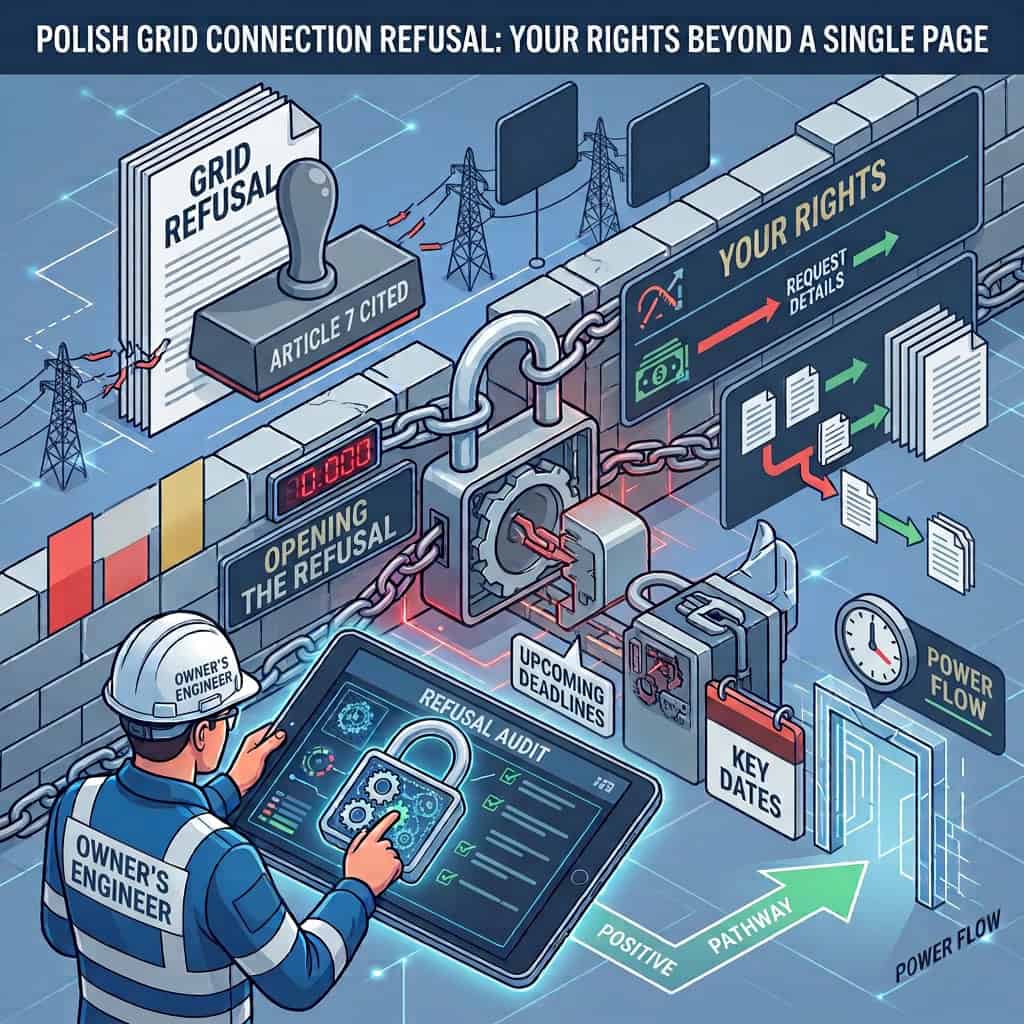
A refusal letter in Poland runs one page. Operators issued nearly five thousand of them last year, covering a record 107 GW. Almost none show the finding behind the single paragraph that does the work.
A refusal decision (decyzja odmowna) concerning connection conditions (warunki przyłączenia) rarely runs past one page: applicant, station, requested capacity, one paragraph citing Article 7 of Energy Law (Prawo energetyczne), then a signature. For the technical lead on a stalled connection, and for the analyst underwriting a Polish RES or BESS position, that page is the entire visible record, and it can end a queue slot, force a site redesign or reopen a signed term sheet.
Behind that paragraph sits a technical or economic finding the operator is legally required to be able to produce, and Polish law gives the applicant two separate ways to demand it. Most refusal letters never show the finding, and few applicants use either route.
What „no technical conditions” is actually supposed to mean
The interpretive standard for a lack of technical connection conditions (brak warunków technicznych) was set out by Rafał Gawin during his term as Prezes URE, in Informacja Prezesa URE nr 15/2024 of 22 March 2024 . Drawing on case law, it defines the ground as an obstacle of a permanent character that cannot be removed despite attempts to do so. Such cases are supposed to be exceptional and described in detail in the refusal itself.
If a connection is technically achievable and the only obstacle is an expansion the operator has not budgeted or scheduled, a bare „no technical conditions” refusal does not meet that standard on its own. The refusal should cite technical and economic grounds together, naming the investment that would be needed and why it is not planned. A refusal resting on the technical ground alone is often incomplete on its face, because it asserts impossibility while describing a budgeting decision. Test that gap first.
The numbers behind a 2025 refusal
URE recorded 4,897 connection refusals in 2025, down from 7,817 the year before. Rejected capacity moved the other way, reaching a record 107 GW against 73.58 GW in 2024. Fewer refusals now cover far larger projects, which turns a queue position from a rounding error into a term-sheet-defining number.
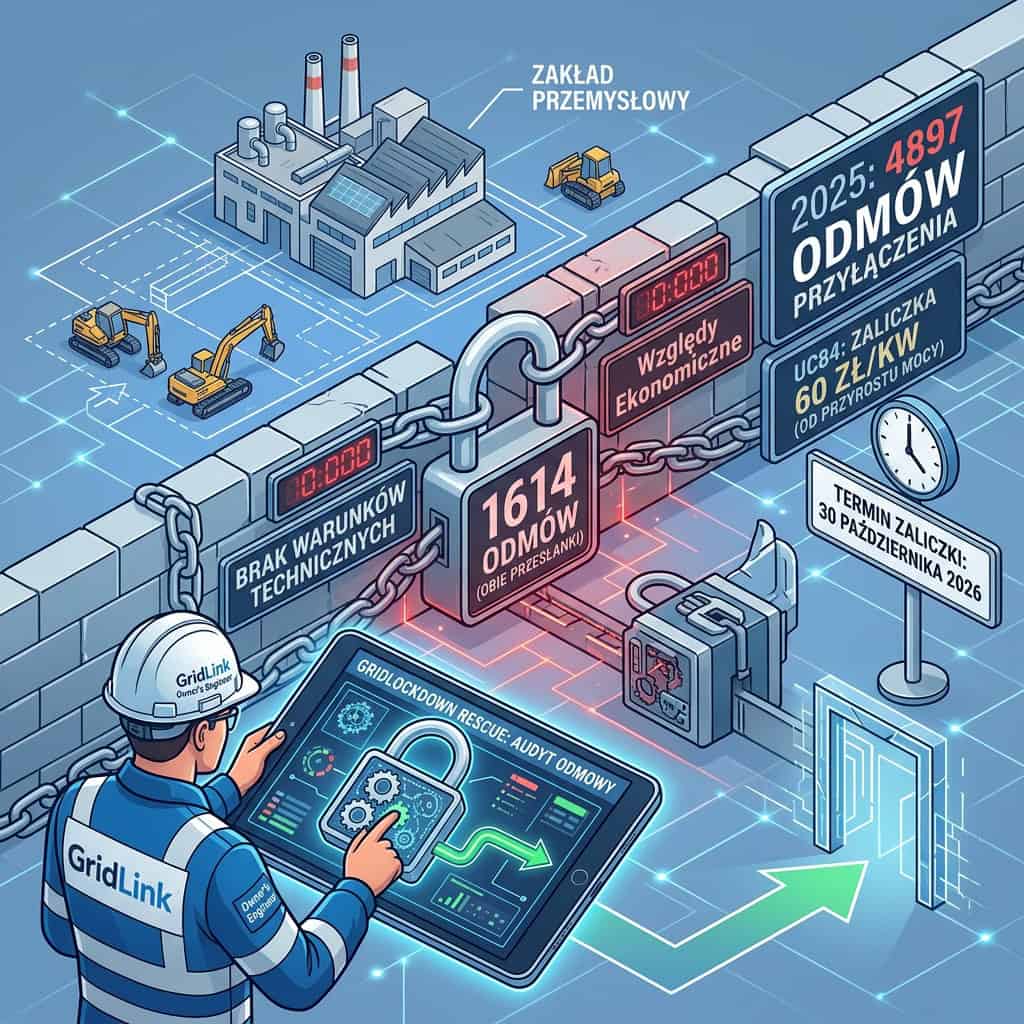
The grounds behind those refusals split three ways, and the third split is the one most commentary drops. In 2025 operators cited a lack of technical connection conditions in 2,133 cases, economic grounds in 1,150 , and both grounds together in 1,614 . Technical grounds alone therefore account for under half the refusals. The combined category, the one the standard above actually calls for, is the second largest by count and by some distance the largest by capacity.
Wardyński i Wspólnicy put the refusal rate for investors’ applications for connection conditions at around 70% in 2025, in a piece published on 30 April 2026. The same analysis cites market estimates of roughly 100 GW of blocked or dead connection capacity sitting in the queue. Hold on to that number.
What the operator owes you after a refusal
Two provisions give an applicant a route to the finding, and they work differently.
§ 4 ust. 14 of the Regulation of the Minister of Climate and Environment of 22 March 2023 on the detailed operating conditions of the power system is the broader one. On the applicant’s request, following any refusal to conclude a connection agreement under Article 7 ust. 1, the operator must set out what would have to be done by way of network expansion for the connection to happen, together with the connection fee under Article 7 ust. 9. The same provision obliges the operator to tell the applicant about this right inside the refusal notice. Note the trigger: the right attaches to any refusal, not only to one resting on economic grounds.
Article 7 ust. 12 of Energy Law is the sharper one. Where a refusal rests on economic grounds, the notice itself must already state the estimated amount of the Article 7 ust. 9 fee together with a statement that the applicant may demand how that figure was calculated. On such a demand the operator has 14 days to set out the calculation method, itemising the significant investment outlays behind it. No dispute, no filing, no stamp duty (opłata skarbowa). A letter is enough.
In practice the flag required by both provisions is often missing. If it is, ask in writing for the expansion scope and the itemised calculation, citing both units. What comes back either substantiates the refusal with a real figure or shows that no such figure exists yet. Either answer changes what you do next.
The same standard applies to capacity increases
Article 8 ust. 1 of Energy Law lists disputes „concerning an increase in connection capacity” alongside new connections in the catalogue URE will hear. The phrase is in the statute verbatim, so a project adding a BESS module to an existing PV connection point, or a plant raising contracted capacity for a new line, does not have to argue its way into the provision. The standard and the route are the same.
One UC84 detail works in favour of exactly this case and is usually missed. Where an applicant already holds connection capacity, the advance against the connection fee is charged only on the increment, not on the whole. Any excess of that advance over the final fee is returned with statutory interest. The cost of re-approaching a station is therefore lower for an expansion than the headline rate suggests.
What you can check before spending on a dispute
Transmission and distribution undertakings carry a statutory duty under Article 7 ust. 8l to publish available connection capacity, with a five-year forward view, for their whole network above 1 kV. The breakdown, however, is given by stations or station groups within the 110 kV and higher network. A project sitting on a medium-voltage feeder will not find its own node in that dataset. The same provision requires operators to publish the pending applications, so the queue ahead of you is visible too.
One property of those figures is easy to miss and worth more than the headline number. The published available capacity is reduced by capacity reserved under connection conditions already issued and still valid . A low figure at your station may describe reservations held by projects that will never be built, and the transformer itself may have room. That distinction is where the 100 GW of blocked capacity cited above actually sits, and it separates a station that is physically full from one that is merely booked by paper projects nobody has withdrawn. The two look identical in a refusal letter.
Operators also publish beyond the statutory minimum. TAURON Dystrybucja runs dostepnemoce.pl, covering issued Connection Condition , contracted capacity by technology and flexibility-service demand by GPZ. Enea Operator publishes a separate map of connection capacity available to consumers, updated daily, which the statutory duty does not reach.
Cross-checking a refusal against a station’s published figures is a real first step and a limited one. Operators routinely decline to release the full assessment of the impact of the connection (ekspertyza wpływu przyłączenia) behind a refusal, citing trade secret (tajemnica przedsiębiorstwa). The published data and the refusal letter are usually the only two documents an applicant sees without commissioning independent technical review, and testing the permanent-obstacle standard properly takes more than a station-level capacity figure.
The cost of getting it wrong twice
UC84 introduced an application fee of 1 zł per kW of requested capacity, capped at 100,000 PLN, on connections to networks above 1 kV. On a 50 MW project that is 50,000 PLN. Resubmitting at a different station after a refusal that was never tested means paying it a second time for the same untested guess, before any security deposit on the new application enters the picture. The question is sharper still if this is not the first refusal at this station.
There is also a date in the calendar. On 28 August 2026 the President declined to sign the act of 31 July 2026 amending UC84’s transitional provisions. That amendment would have pushed the deadline for paying the advance from 30 October 2026 into April 2027 and resolved the ambiguity between the 100 percent security level applying to 15 October 2026 and the 25 percent level from 16 October. After the veto the original dates stand.
The dispute route itself
A dispute under Article 8 goes to the competent URE regional branch, filed with proof of stamp duty (opłata skarbowa) payment. The exemption from that fee covers purely residential objects only, which rules it out for a RES, BESS or industrial applicant. URE resolves the dispute by administrative decision (decyzja administracyjna), appealable to the Sąd Ochrony Konkurencji i Konsumentów in Warsaw. It runs on the same technical record the refusal letter was supposed to disclose in the first place.
Before deciding to challenge it
Three questions to run against the letter first
Does the refusal cite no Connection Condition alone, with no economic ground named alongside it?
Does the letter mention your right to request the expansion scope and its cost under § 4 ust. 14, and, where economic grounds are cited, does it state the estimated Article 7 ust. 9 fee and your right to its calculation?
Does the operator’s own published station data conflict with the technical finding in the letter, and how much of the station’s shortfall is capacity already reserved under issued connection conditions?
If a station is publicly listed as at capacity with no forward headroom in the operator’s own five-year figures, and the refusal names that same limit, a dispute is unlikely to change what the network can physically carry. Move the station instead. A dispute earns its cost when the refusal’s technical premise has never been tested against the standard URE itself applies.
A technical lead can run these three questions against the refusal letter and the published figures directly. An analyst without that engineering read in-house still needs the same three answers before a term sheet gets reopened or a position gets marked down.
Where GridLink fits
GridLockdown Rescue is GridLink’s audit of the refusal decision itself. We test the stated grounds against the permanent-obstacle standard, cross-check them against published station data, check whether the letter carries the notices both provisions require, and state plainly whether a given refusal is defensible network physics or a paper decision that was never properly justified. The output is a technical opinion built to support a dispute filing, or to give an investment committee a clear read on whether the project is still alive.
The review is analytical. We calculate and check the operator’s stated grounds, then take a position on whether they hold. We do not act as designer or general contractor, and we do not promise a reversed decision, because no engineer can guarantee how URE or a court will rule. A legal team turns the technical read into the filing. Our engineering side is led by Michał Gajdzica, PhD, GridLink’s co-founder and an academic lecturer specialising in power systems, protection and the technical assessment of large generating assets. The team has more than 800 MVA connected to the Polish grid behind it, across HV and MV projects.
Start with the three questions
Not ready to send the file yet? Run your refusal letter against the three questions above and send us just the answers. We will tell you in one message whether they point to a real dispute or a different station.
Ready to send the file? Send the refusal letter and the original connection application and we will tell you whether the stated ground meets the standard URE applies, and what a dispute filing would need to show if it does not.