Most compliance guides for foreign renewable investors in Poland cite a 100 MW rule of thumb for reporting under the Regulation on Wholesale Energy Market Integrity and Transparency, known as REMIT (Regulation (EU) No 1227/2011). It is the EU-wide regulatory framework designed to ensure transparency and integrity in wholesale electricity and natural gas markets, specifically by prohibiting insider trading and market manipulation. That number appears nowhere in the regulation. The Agency for the Cooperation of Energy Regulators (ACER) has never set a fixed threshold for what counts as inside information, and Ofgem told UK market participants this April that relying on any fixed MW figure is unreliable by design.
For a foreign-owned mid-cap wind or solar asset in Poland, the real exposure sits in that gap between assumption and law. Your own deal counsel will find it before any regulator does.
At the same time, Poland is preparing a separate and unrelated change: a return of the Polish Power Exchange (TGE) trading obligation, the so-called obligo giełdowe. The two developments get confused constantly, including in content written for this exact audience. They come from different legal instruments and move on different timelines, and the penalties differ too. Foreign IPPs scaling portfolios above 10 MW need a clear, separate picture of both.
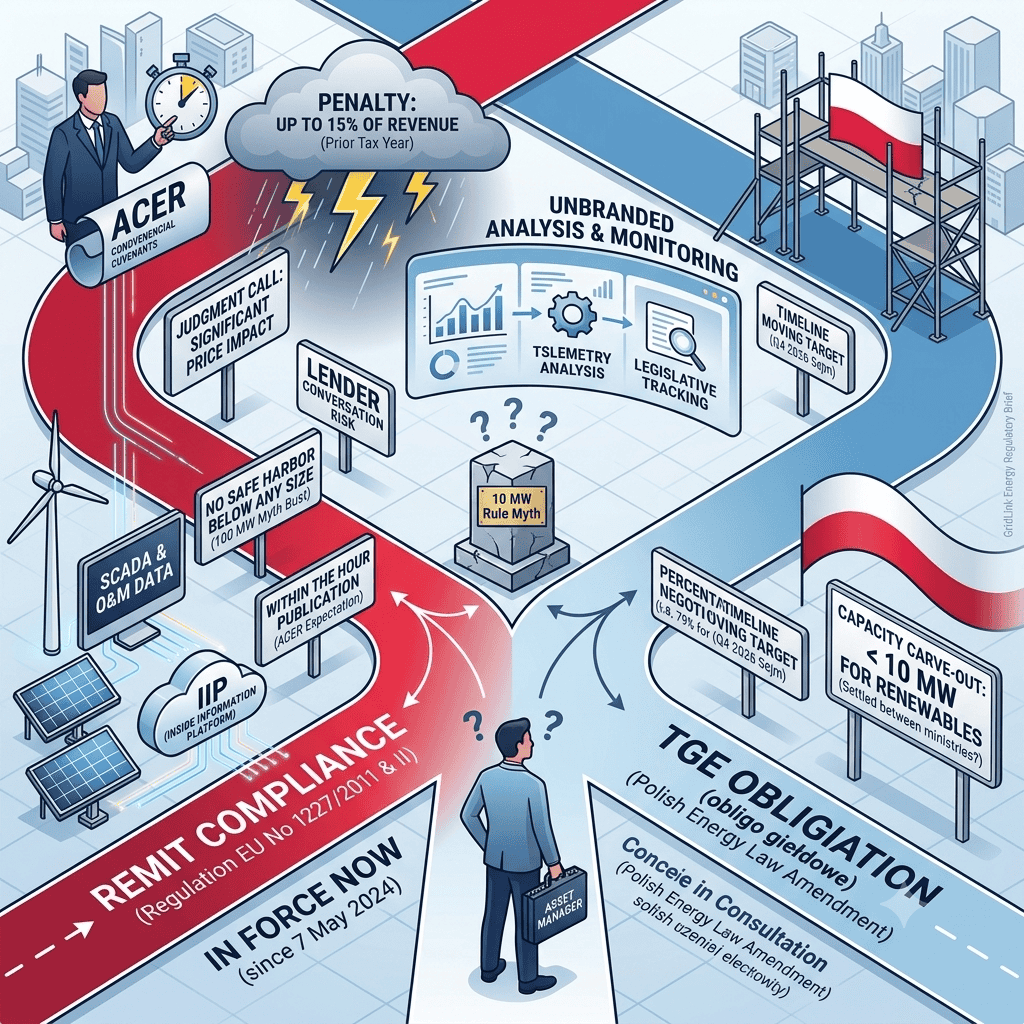
REMIT: no safe harbor below any size
Regulation (EU) 2024/1106, known as REMIT II, entered into force on 7 May 2024 and expanded the EU’s market abuse and transparency regime. Third-country market participants operating in the EU now need a designated representative registered in a Member State, and reporting obligations for persons professionally arranging or executing transactions have widened.
What REMIT II did not do is introduce a capacity threshold for inside information. Article 2 of REMIT defines inside information to include the capacity and availability of a market participant’s facilities whenever it could significantly affect wholesale energy prices, and Article 4 requires market participants to disclose that information in an effective and timely manner. Whether a given outage clears that bar is a judgment call, made asset by asset, event by event.
Some markets have adopted a working convention around 100 MW for internal screening purposes, but that convention has no legal force, and regulators have started pushing back on it as unreliable. In practice, a 12 MW or 15 MW Polish asset gets no exemption by virtue of being smaller than some informal industry number. The question is always whether the specific event moves the market. Nameplate capacity clearing an informal bar has no bearing on that assessment.
The Polish Power Exchange (TGE) obligation is still a moving target
The second layer is Poland’s exchange trading obligation, which was scrapped in 2022 and is now being reintroduced through a draft amendment to the Energy Law (Prawo energetyczne). As of mid-2026, it is still a bill working through consultation, without legal force. The energy minister has confirmed that the draft should reach the Sejm in the fourth quarter of 2026. The two issues most relevant to this audience—the treatment of renewables and the exemptions for intragroup contracts—are expected to be settled between the ministries in July. The originally floated implementation date of 1 July 2026 has already passed without the obligation taking effect.
The numbers have moved during consultation. The proposed obligation for electricity stood at 80 percent in the autumn 2025 draft and was revised down to 70 percent, as confirmed by the energy minister in June 2026. The 85 percent figure that circulates in market commentary belongs to natural gas, where the obligation is set to rise from the current 55 percent.
The draft does include a capacity-based carve-out relevant to this audience: renewable installations with total capacity below 10 MW would be excluded from the obligation entirely. The Ministry of State Assets went further during consultations, proposing that renewable energy be excluded from the TGE obligation altogether. Assets at or above 10 MW would in principle fall within scope, subject to whichever exemptions survive the July negotiations.
Some market content attaches this 10 MW figure to REMIT reporting, which creates a separate confusion worth untangling. REMIT does carry its own 10 MW threshold, but it governs a different rule: contracts for physical delivery from a production unit at or below 10 MW are reportable only at ACER’s request, and the market participant is not required to register with the national regulator for those contracts alone. That threshold has nothing to do with the disclosure of inside information under Article 4, and nothing to do with the TGE carve-out either. Three separate rules share the same number, and building a process around the wrong one is how that confusion gets expensive.
What this means operationally
For a foreign-owned Polish renewable asset above roughly 10 MW, two separate compliance tracks need attention on two separate timelines:
- REMIT disclosure obligations apply now, with no threshold-based exemption, and depend on internal processes that connect SCADA data, O&M reporting, and a compliance function that understands what qualifies as inside information under Article 4.
- The TGE obligation is still being negotiated between three ministries. Its final percentage and its treatment of renewables remain open until at least July, and the earliest realistic implementation window has already slipped past the middle of 2026.
ACER’s guidance expects inside information to be published as soon as possible, and in practice within the hour. That is a bar an O&M escalation chain was never designed to meet.
Failing to publish REMIT-required information is its own named violation under Polish law, Article 56 of the Energy Law (Prawo energetyczne), enforced directly by the President of URE with fines running up to 15 percent of the company’s revenue from the prior tax year. On a mid-cap SPV, a fine scaled to revenue is not a compliance line item. It is a covenant conversation with your lender.
Waiting for the TGE bill to reach its final form before building reporting infrastructure is a reasonable instinct for that specific obligation. REMIT works on a different clock: it has been in force since 7 May 2024, and the reporting rules under it keep moving too. A revised Commission regulation, built on ACER’s technical standards, tightened the reporting timeframes again as of 29 April 2026.
For investors evaluating an acquisition, a REMIT gap tends to surface at the worst possible moment: during technical due diligence, when a buyer’s counsel asks who has been deciding what counts as inside information and finds no documented answer. That single gap can stall a closing by weeks or reopen the price.
Operational questions we hear from asset owners
Does my asset need to worry about REMIT reporting if it is under 100 MW?The 100 MW figure is not a legal exemption. REMIT applies based on market impact. Installed capacity alone does not create an exemption for smaller assets.
Can our standard O&M provider handle this?Usually not directly. O&M contracts are built around hardware and yield. Deciding in real time whether a given outage qualifies as inside information, and coordinating that decision through an Inside Information Platform (IIP), a certified platform used for publishing inside information, sits outside their scope. If TGE reporting requirements apply once the bill passes, that adds a separate reporting layer on top, typically handled through the exchange itself or a registered reporting mechanism rather than by an O&M team.
Should we build reporting processes now for the TGE obligation?It depends on your risk tolerance and your asset size. If your installation is likely to sit above whatever final threshold the law settles on, tracking the legislative process closely is worthwhile so you are not building against a moving target. REMIT compliance sits on different footing entirely: it has been binding since May 2024.
If you are not sure which of these three questions applies to your portfolio, that is itself worth a short conversation before you build anything.
Where GridStaff Compliance fits
GridLink’s engineering lead, dr inż. Michał Gajdzica, has worked on the technical side of grid connection and compliance for generation assets totaling more than 800 MVA connected to the Polish grid, spanning NC RfG compliance work. GridStaff Compliance applies that same engineering-first approach to REMIT and TGE monitoring: translating raw SCADA and asset data into the disclosures REMIT actually requires, and tracking the TGE draft closely enough that you are neither overbuilding for a rule that may exclude renewables nor underbuilding for one that does not.
The decision whether an outage is inside information starts with the same telemetry we read during commissioning and compliance testing, which is why an engineering team, and not a template, sits at the front of the process. The same team supports technical due diligence and reliance letters, reading a REMIT or TGE gap for what it does to timing and price, and what lands in the warranties.
Two questions are worth asking before a deal or an audit forces the answer:
- Who on your team decides today whether an outage qualifies as inside information?
- Could you produce the documented trail behind that decision for your Polish assets right now?
We build the monitoring around what the regulation actually says today, and we flag it the moment that changes. No fixed package sold around a threshold that was never written into the law.
REMIT carries no grace period while Warsaw finishes the TGE bill. It has applied in full since May 2024, and it keeps applying no matter what the ministries settle in July or the Sejm takes up in the fourth quarter.
Send us your current REMIT disclosure log, or tell us if one does not exist yet. We will tell you within a week where the gaps are, at no cost and under NDA.
Book a REMIT and TGE exposure review before the ministries close the renewables question this month. Contact GridLink to schedule it.