Poland’s draft exchange obligation carves out Renewable Energy Sources (RES) units below 10 MW while leaving non-RES units outside the obligation all the way up to 50 MW. A 12 MW solar farm is captured. A 45 MW gas engine is not. Energy Minister Miłosz Motyka confirmed on 24 June 2026 that the electricity obligation had come down from 80 percent to 70 percent, that two questions remained open with the Ministry of State Assets and the Ministry of Climate, and that the bill reaches the Sejm in the fourth quarter. Whether RES is carved out entirely is one of those two questions. The operational layer underneath has a deadline that is already law and does not wait for the answer.
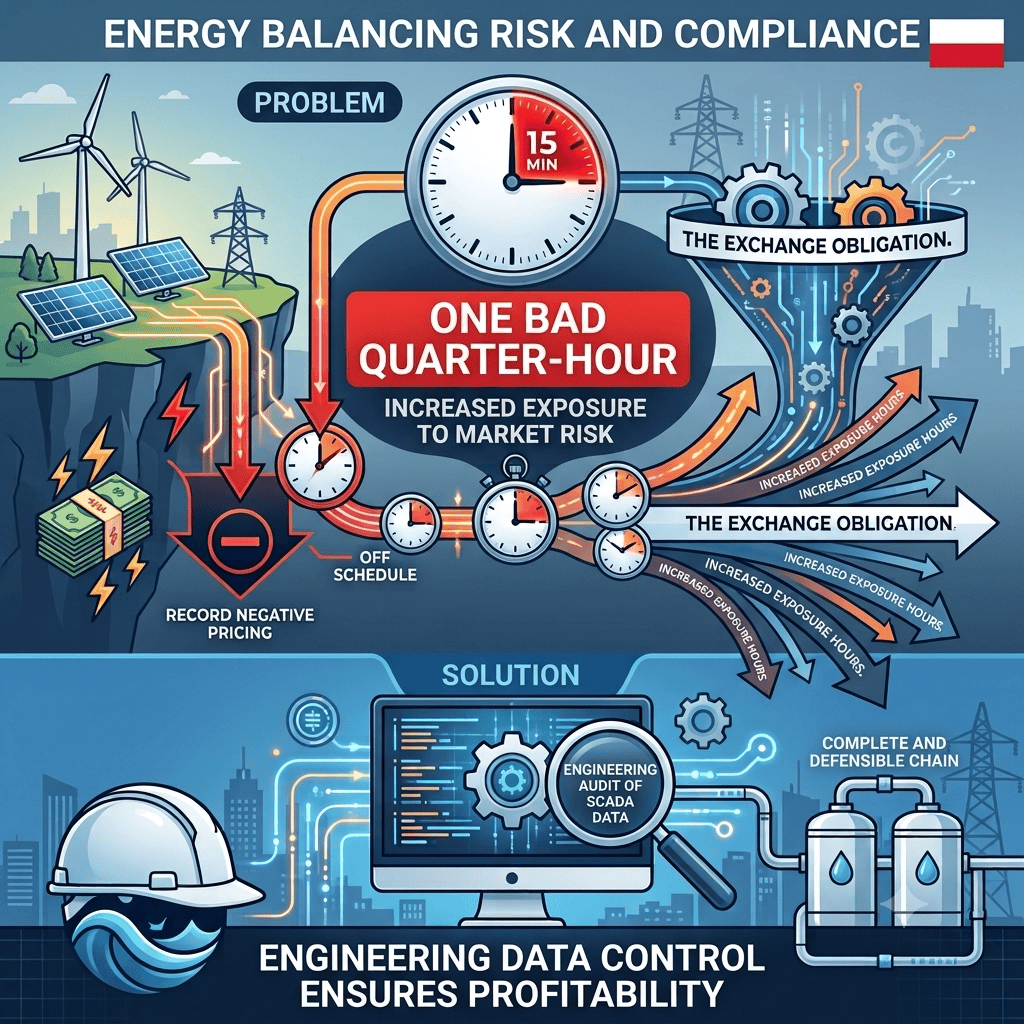
What a single quarter-hour of imbalance actually costs?
Poland moved to 15 minute imbalance settlement on 14 June 2024. Since 1 October 2025 the Day-Ahead Market has priced energy in 96 intervals per day, which is 35,040 separately settled periods a year. Volume delivered or withdrawn outside schedule settles at the market price for that specific interval, published by operator as Market Price of Electricity – Rynkowa Cena Energii elektrycznej (RCE).
On 29 October 2025, between 09:30 and 09:45, that price reached minus PLN 44,800.17 per MWh, the deepest print in the history of the Polish market according to operator’s own reporting. The previous record of minus PLN 36,932.50 per MWh had stood since 30 July 2025. On 21 September 2025 the market ran 29 consecutive negative intervals and closed with Poland’s first negative daily average price at minus PLN 145 per MWh.
A 20 MW asset, one interval, at the record price
- A forecast error equal to 25 percent of capacity, meaning 1.25 MWh delivered off schedule: PLN 56,000.
- The full quarter-hour output off schedule, meaning 5 MWh: PLN 224,001.
- The same two cases at the July 2025 record: PLN 46,166 and PLN 184,663.
- PSE estimates the cost of lost benefits arising from imbalance across the market could exceed 1 billion PLN in 2026.
Direction of exposure matters here and is where offshore-written analysis usually goes wrong. A weather-driven forecast miss on a bright, windy morning leaves the asset long, pushing unscheduled volume into a price that can sit deep in negative territory. An inverter trip or a redispatch instruction leaves the asset short, buying back from the expensive end of the activation stack. Operator states the position without decoration: a party injecting or withdrawing energy outside its schedule does not know the settlement price and exposes itself to significant financial loss.
The exchange obligation does not create this risk. It increases the number of hours you sit inside it and adds a documentation burden on top.
What 70 percent does to your revenue model?
Seventy percent of generated volume routes through Polish Power Exchange – Towarowa Giełda Energii (TGE) or a NEMO platform. Thirty percent is the entire headroom left for anything bilateral, and that headroom has to cover every contract your financing case assumes.
The draft exempts a corporate PPA concluded directly between the generator and an end consumer. PSEW put on record during consultations that the large majority of PPAs signed on the Polish market run between the generator and a trading company, and that the draft does not exempt that structure. If your revenue case and your debt sizing rest on a PPA with a spółka obrotu, this is the provision most likely to move your numbers. Read your contract against the exemption wording while the text is still moving between ministries.
There is a licensing consequence that surfaces late. A Polish generation licence does not permit buying energy back, so an SPV that needs to correct its contracted position after a forecast update requires a separate trading licence, the koncesja na obrót energią elektryczną. Proceedings before the President of URE run on their own clock. Across a portfolio of SPVs that becomes a sequencing problem rather than an administrative one.
Who this does not apply to?
Before committing budget, confirm which side of the threshold your assets sit on. Four situations where this is not your problem:
- RES units below 10 MW, provided the capacity test for your configuration does not aggregate units sharing one connection point.
- Non-RES units up to 50 MW.
- Energy consumed on site and energy supplied to an end consumer over a direct line.
- Assets under CfD support, where industry argues the obligation is unjustified because output already settles against exchange indices. That argument remains unresolved and warrants monitoring rather than spend.
If your portfolio sits inside any of these, the trading layer can wait. The metering and market data layer will reach you regardless, which is the next point.
One date that does not wait for the Sejm
CSIRE, the central energy market information system operated by operator in its role as OIRE, enters its full mandatory phase on 19 October 2026, covering every system user without exception. That date is already law.
Two things worth separating, because vendor decks collapse them into one line. CSIRE is fed with metering data supplied by the grid operators and runs retail market processes. Your SCADA system and telemetry talk to the dispatch systems of your DSO and TSO under IRiESD and IRiESP grid codes. Different systems, different counterparties, separate budgets, separate deadlines. Treating them as one integration project is the most common reason a Polish readiness schedule slips.
Redispatch compensation sits in the same bill
The obligation bill also changes how non-market redispatch, redysponowanie nierynkowe, is settled. Settlement is to cover the metered energy plus the energy that would have been generated had the operator not issued the curtailment instruction, with the cost falling on the operator that issued it.
The method for determining unproduced volume goes into IRiESP and IRiESD. Industry is pushing for it to rest on production-parametrising devices, the estimators already used under the offshore act. The practical consequence for an owner is direct. The completeness and defensibility of your SCADA system record becomes evidence in a settlement with the operator, priced at every curtailment event.
Assets without continuous logging of available power, resource data and limitation signals will enter that mechanism unable to substantiate a claim. This is the only part of the package that can pay you rather than cost you, and it needs engineering work rather than trading work.
You can check your POB against operator’s published data
Operator monitors balancing performance across all POBs and publishes the results on a recurring basis. Its March 2026 report states that some POBs systematically carry large portfolio imbalances and take no trading action to close them, including basic steps such as activating 15 minute contracts or trading intraday. PSE adds that 15 months after the balancing market reform, the list of the worst performers has not changed.
Those reports are public and in Polish. Before you hand profile risk to a counterparty, you can see how that counterparty has actually been performing in the system operator’s own data. It is the cheapest diligence available on the entire arrangement and very few foreign owners run it.
Four routes to market, and the arithmetic behind each
- Direct exchange membership. Full control over execution and forward hedging on BASE and PEAK products, set against membership fixed cost, IRGiT transaction and security collateral updated daily, the trading licence question above, and an internal desk. Run that arithmetic against annual volume before assuming it clears at the lower end of a 10 to 30 MW band.
- Representation through a brokerage house. A dom maklerski executes on your behalf while an independent POB carries profile risk. Splitting execution from balancing is useful, and it puts the burden on you to keep the two contracts consistent.
- Full-service aggregator. One counterparty acts as POB and market access provider and absorbs profile risk against a set discount to a TGE index such as TGeBase or TGe24. Lowest internal overhead, and the discount is where the whole commercial negotiation lives.
- Physical corporate PPA cleared through the exchange. Keeps fixed-price protection while satisfying the volume obligation, provided delivery genuinely clears through TGE and the counterparty structure matches the exemption as drafted.
Two structures that create real exposure
- Pushing full volume onto the Day-Ahead Market without a hedging mandate, which leaves the asset open to negative prices and to curtailment, both already eroding project IRR under current Polish grid constraints.
- Running on legacy bilateral agreements whose volumes never clear through IRGiT, which becomes a compliance gap the moment the obligation applies.
How we work?
GridStaff Compliance gives your SPV a fractional Polish operations team on the owner’s side of the table. Four steps, each with a named deliverable.
- Step 1, exposure review. Your schedule deviations mapped against the settlement price for the same intervals. You receive the distribution of imbalance cost across quarter-hours and a split showing how much came from forecasting and how much from plant behaviour.
- Step 2, operating layer audit. Telemetry, signal mapping, continuity and archiving of the SCADA system record against IRiESD, IRiESP grid codes and CSIRE requirements. You receive a signal compliance report with gaps and dates.
- Step 3, contract review from the engineering side. POB and brokerage agreements read for allocation of balancing risk, data input obligations and penalties tied to quality parameters. You receive a list of clauses to renegotiate with the technical reasoning behind each.
- Step 4, redispatch evidence chain. Logging of available power, resource data and limitation signals put in order. You receive a documented procedure for determining unproduced volume, ready to put in front of the operator.
The engineering is led by dr inż. Michał Gajdzica, co-founder of GridLink, academic lecturer and specialist in power systems, protection and technical assessment of large generating assets. The team’s discipline comes from grid connection work totalling more than 800 MVA connected to the Polish operator’s network.
That background matters for one specific reason. A missed curtailment instruction or a wrong nomination appears in a POB settlement statement and in a connection compliance file at the same time, and the engineers who read one read the other.
We work on the owner and investor side. We calculate, analyse, review and report, and we flag risks and recommendations. We do not take over the role of designer or general contractor, and we do not guarantee an administrative outcome.
Four questions for your Polish portfolio
- What was your most expensive single imbalance interval in the last twelve months, and does anyone in the SPV know that number without looking it up?
- Is your PPA signed with an end consumer or with a trading company?
- Where does your POB sit in PSE’s published balancing performance reports?
- Would your SCADA archive substantiate unproduced volume after a redispatch instruction, in a form the operator would accept?
Four documented answers mean the RES carve-out decision changes your commercial model without threatening operations. One missing answer means the gap is costing you capture price today and converts into regulatory exposure the moment the obligation lands.
Two ways in, both starting from your data
Exposure review, five business days. Send twelve months of schedule deviation exports and your POB agreement. You receive the distribution of imbalance cost across quarter-hours, the largest single events identified, and the contract clauses that let them through. No fee on the first asset.
Readiness review closing before 19 October 2026. Telemetry, metering, CSIRE registration status and redispatch evidence, delivered as an action list with owners and dates. We are booking September slots until 31 August. Project data, operating documentation and SCADA systems exports under NDA.